Navigating New England’s Elite Music Schools & Choosing Your Audition Instrument
VERMONT VIOLINS NEWSROOM – As the back-to-school season approaches across New England, young string players and their families face a pivotal transition. For high school students aspiring to take their music to the professional level, as well as undergraduates preparing for advanced graduate studies, choosing the right higher education environment is one of the most significant decisions in a musician’s journey.
New England boasts one of the highest concentrations of world-renowned music schools, conservatories, and university string programs on earth. But navigating the application process, trial lessons, and audition preparation can often feel overwhelming.
Below is an insider’s overview of New England’s premier music institutions, key insights on how prospective students can choose the right program, and a look at the essential acoustic partnership between a player and a conservatory-ready instrument.
Mapping New England’s World-Class Music Programs
When exploring higher education in music, New England and its neighboring East Coast hubs offer a rich spectrum of artistic environments. Each institution carries a distinct culture, pedagogical philosophy, and community structure:
New England Conservatory (Boston, MA): A historical powerhouse offering intense, traditional conservatory rigor with deep ties to the Boston Symphony Orchestra.
Boston Conservatory at Berklee (Boston, MA): A vibrant, highly collaborative environment blending traditional classical excellence with progressive multi-genre performance and contemporary arts.
Yale School of Music (New Haven, CT): A prestigious, fully funded graduate institution known for elite chamber music, orchestral performance, and deep academic resources.
East Coast Preeminent Institutions (Juilliard, Curtis): Renowned hubs in New York City and Philadelphia that regularly draw New England string players into their audition pipelines for world-class undergraduate and graduate tracks.
Eastman School of Music (Rochester, NY): A world-famous conservatory embedded within a major research university (University of Rochester), known for its top-tier orchestral performance, comprehensive music education, and pioneering jazz programs.
Mannes School of Music (New York, NY): Part of The New School, Mannes is celebrated for its progressive, artist-centric approach, deep commitment to music theory, and seamless integration into NYC’s professional contemporary and classical scenes.
Peabody Institute (Baltimore, MD): The nation's oldest music conservatory—affiliated with Johns Hopkins University—combining classical tradition with cutting-edge academic and interdisciplinary opportunities.
The Crane School of Music (Potsdam, NY): Located at SUNY Potsdam, Crane is a renowned public institution famous for its exceptional music education programs, large-scale ensemble tradition, and accessible state-university framework.
How Prospective Students Should Evaluate Schools
Choosing a conservatory or university music department goes far beyond institutional name recognition. Prospective students and parents should consider three primary pillars during their search:
1. Studio Teacher Alignment and Trial Lessons
For string players, the relationship with your private studio teacher is the single most important factor in your collegiate development. Some students apply seeking specific "big name" master teachers. However, taking trial lessons with multiple faculty members is the most reliable way to find an instructor whose communication style, technical approach, and personality click naturally with your learning style.
2. The Community and Ensemble Culture
Music is inherently an outwardly motivating, collaborative journey. Transitioning away from home to college can sometimes leave students feeling lost. Being surrounded by a tight-knit community of peers who share your exact passion provides immediate encouragement and emotional grounding. Look closely at both the formal ensemble offerings (symphony orchestra, structured chamber music) and the informal, student-led playing opportunities that allow you to explore music without the stress of grades.
3. Balanced Educational Offerings
Parents and students should evaluate the broader ecosystem of the school: how early childhood outreach, community music connections, and career development resources are integrated into the curriculum to prepare graduates for a sustainable lifetime in the arts.
What Makes an Instrument "Conservatory-Ready"?
A successful audition relies on a seamless partnership between the player’s technical ability and their instrument's acoustic capacity. When auditioning for conservatory faculty or performing pre-screening videos, your instrument must meet demanding tonal expectations.
A conservatory-level instrument does not require a famous historical label or an astronomical price tag. Rather, it is defined by emotional connection and sound quality. When a player finds an instrument they truly love, their confidence surges—allowing emotional passion to project clearly through the music.
The V. Richelieu™ Connection: Bench Science on the National Stage
For years, Vermont Violins and V. Richelieu™ Instruments have crafted violins and violas engineered to meet the exact acoustic demands of advancing students and conservatory audition candidates. Built in our Green Mountain workshop, V. Richelieu™ instruments have earned quiet praise across the national conservatory circuit.
During audition trials at major conservatories across the country—from East Coast trials to in-person masterclasses—faculty members and professional orchestra players have repeatedly paused auditions to inspect V. Richelieu™ violas. Surprised by the deep, resonant tone coming from a regional American workshop, master teachers have praised the instruments' rich tonal capabilities, proving that V. Richelieu™ violas and violins compete directly on the national conservatory stage.
Advice for Fall Audition Candidates
As fall pre-screening recordings and live audition dates approach, remember to trust yourself and your preparation.
Audition panels and conservatory faculty are not unapproachable authorities searching solely for mistakes; they are fellow musicians, humans, and former students who were once in your exact shoes. A single missed note or minor intonation slip will not dictate your outcome. What truly stands out is your personal passion, your artistic voice, and the confident connection you share with your instrument.
Many auditions begin with a recorded submission, making high-quality audio essential. You do not need to spend a fortune; investing in a budget-friendly audio recorder—such as a recoridng device—will capture your instrument's tone clearly. While hiring a sound engineer is ideal, it can quickly become expensive.
Remember: if two musicians perform equally well, the person with the superior recording quality will almost always get the gig. A modest investment in gear yields a significant return. Search online for secondhand or affordable recording equipment, or at the very least, purchase an external microphone for your smartphone to drastically improve your sound.
Trial Conservatory-Ready Instruments at Vermont Violins
Are you or your student preparing for college music auditions this year? Visit our South Burlington showroom to trial our collection of V. Richelieu™ violins and violas, explore professional bow pairings, and consult with our team to ensure your setup is fully calibrated for audition success.
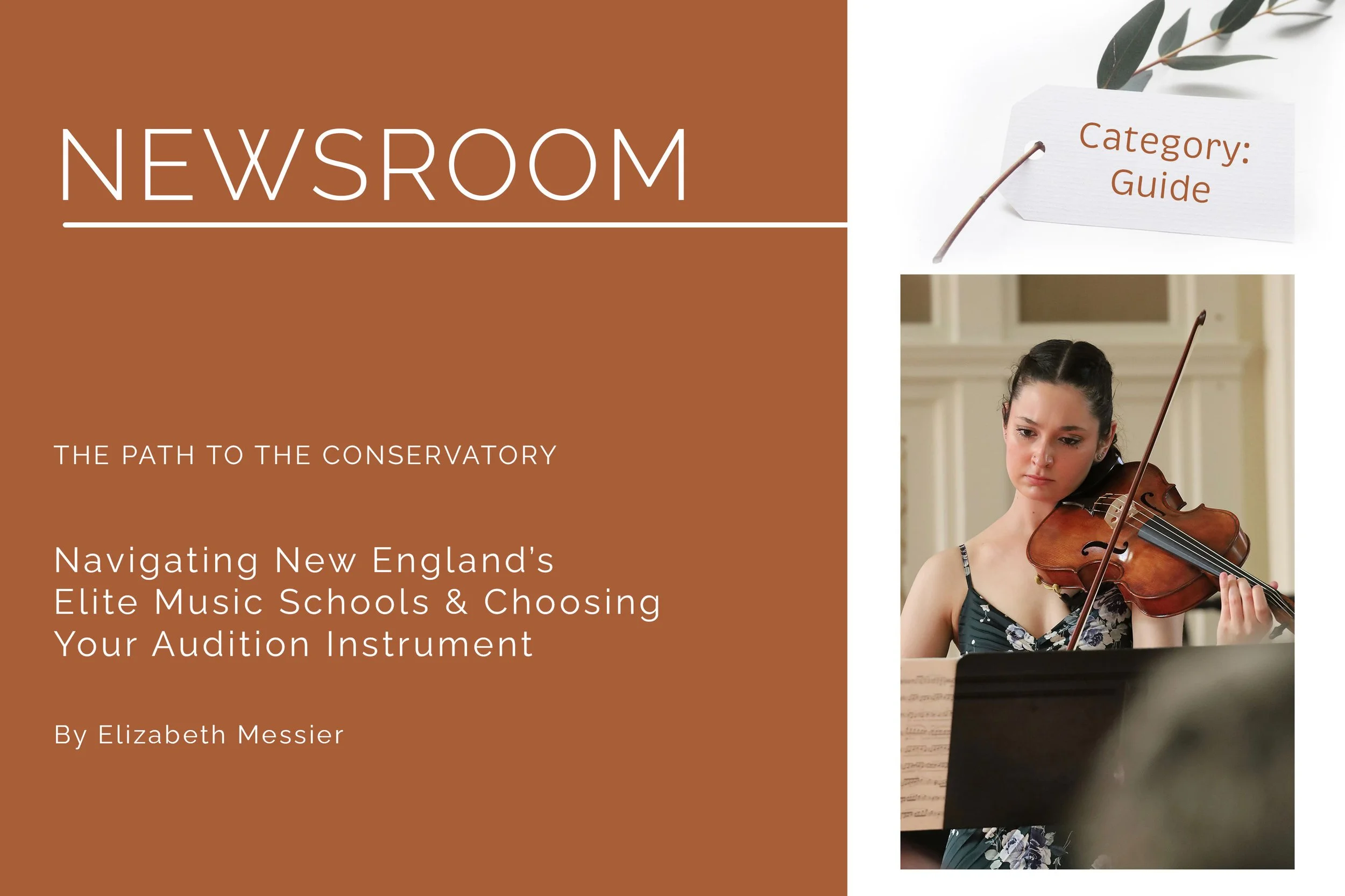
This comprehensive guide and conservatory perspective is brought to you through an insightful conversation with Elizabeth, who has not only been a beloved "poster child" and longtime community member here at Vermont Violins, but someone we are immensely proud to call a home-grown Vermonter. As a deeply well-traveled violist, Elizabeth brings a wealth of real-world audition experience to advancing students—including a recent trip to Long Beach, California, where a prospective graduate professor was so struck by the acoustic power and depth of her V. Richelieu™ viola that he stopped the lesson mid-piece just to play and inspect the Green Mountain-made instrument himself. We are thrilled to celebrate Elizabeth as she continues her journey into graduate studies at the Boston Conservatory at Berklee!
*This article was released by Vermont Violins on August 11, 2026. For media inquiries, product information access, or scheduling availability regarding our imported instrument collections, contact us directly at info@vermontviolins.com* or text us at 802 648 6371