
The Anatomy of the Violin
PARTS & MECHANISM
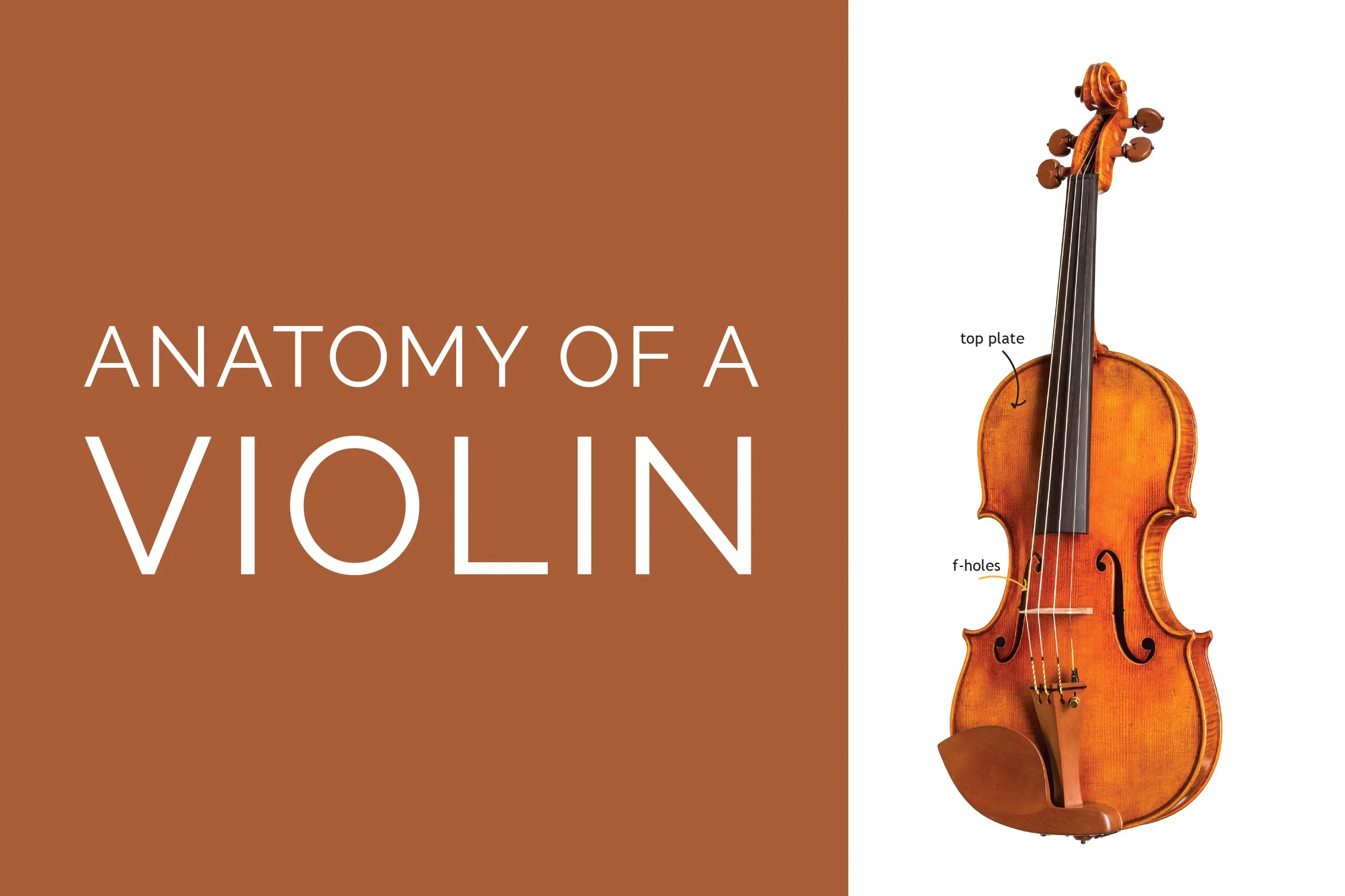
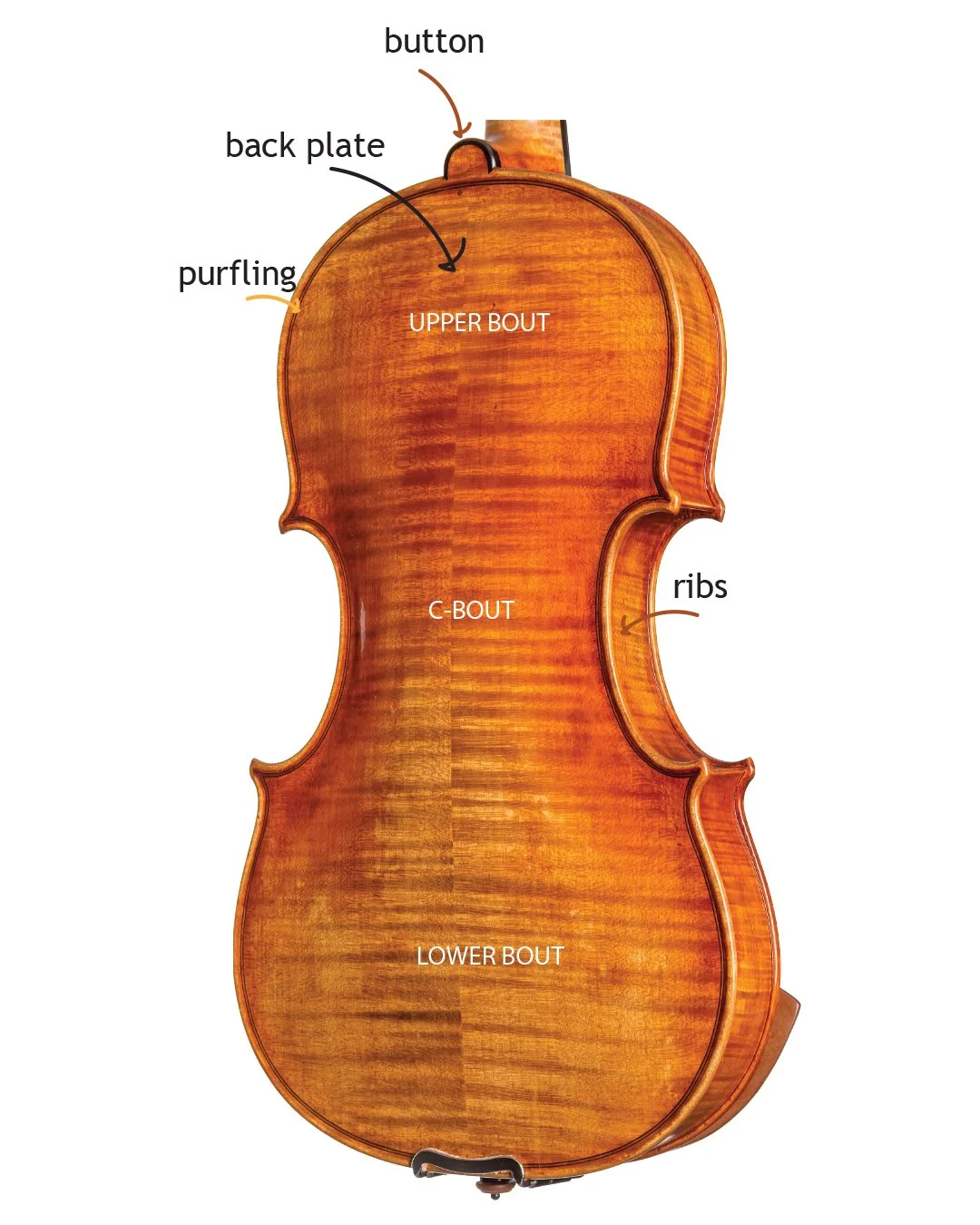
The violin, while seemingly simple, is a complex and beautifully crafted instrument. Understanding the anatomy of a violin can deepen your appreciation for this intricate instrument and enhance your playing experience. The violin body is divided into three sections: the Upper Bout, C-Bout and Lower Bout
THE BODY:
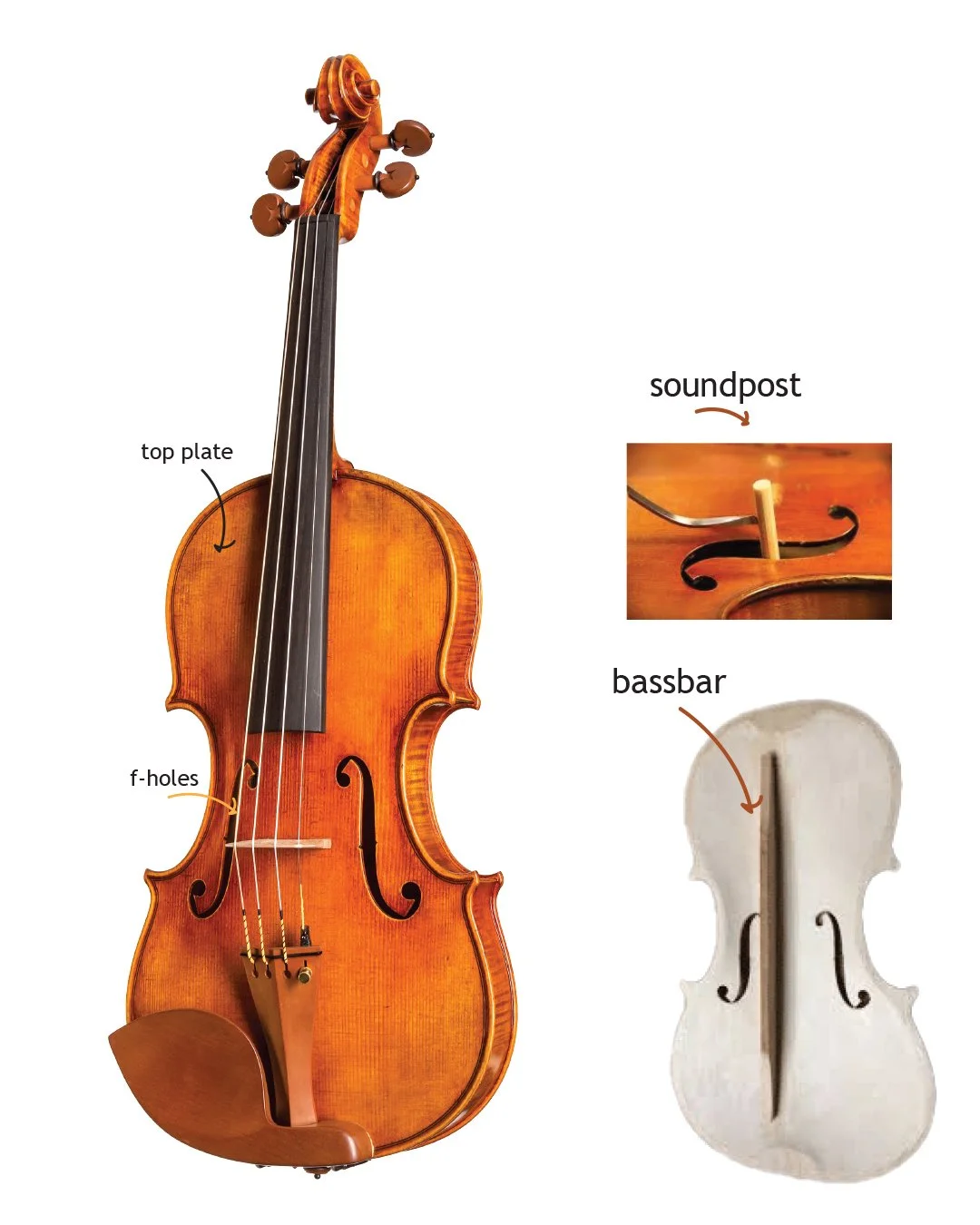
Top Plate: Made of a softer wood, usually spruce, the topplate defines the quality of the instrument’s tone. The overall outline, the slopes and curves, the carved thicknesses (“graduations”) all contribute to creating the maker’s intended sound.
Back Plate: Made of a harder wood, usually maple, the backplate both shapes the tone and projects the sound outwards towards the audience. An instrument’s overall volume and quality of tone is affected by the wood selection, the carved thicknesses (“graduations”), slopes and curves and overall outline.
Purfling: This two-lined inlay serves multiple purposes. Visually, the lines frame the instrument, defining the shape of the instruments visually. Structurally, the purfling helps prevent cracks from developing, especially in the endgrain areas at the top and bottom of the instrument.
Ribs: These thin strips of wood connect the top and back, forming the sides of the instrument. The ribs are shaped using a heated iron.
Soundpost: A small dowel inside the instrument, carefully and precisely carved and set, transmits the vibrations of the string, bridge and top plate to the backplate. It also supports the Top Plate. The region carved around the Soundpost is the most critical region of the plate for sound generation. Where the soundpost is set, slightly back from the treble bridge foot, affects the instruments tone dramatically and the tone-balance of the four strings.
Bass Bar: A long bar glued and suspended laterally along the length of the Top Plate, near the bass side F-Hole. The bassbar prevents the top from collapsing and supports the bass register of the instruments tone.
F-holes: These visually stunning carved holes of the instrument add speaker-level release of sound to the outside of the instrument. They also provide access to the soundpost for adjustment when needed. The small horizontal “f” marks in the center theoretically point to the bridge feet location. Placement, shape and size of the f-holes contribute to the volume and quality of the instrument’s tone.
NECK & SCROLL:
Neck: Usually made of maple, the neck supports the fingerboard and connects to the body.
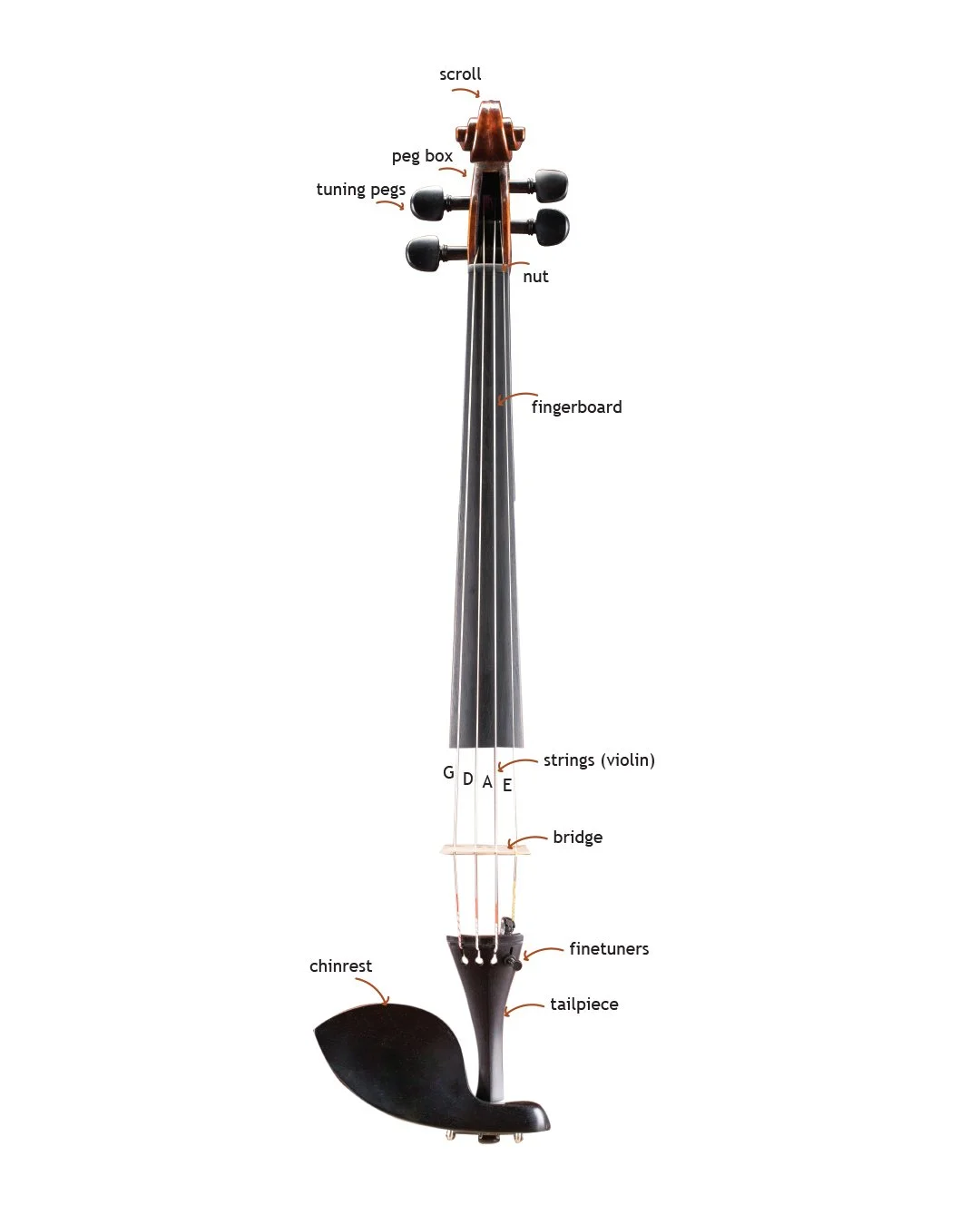
Fingerboard: A smooth, dark wood (typically ebony or a suitable alternative) glued to the neck, where the fingers press down on the strings to change pitch.
Scroll: Drawing on design concepts of the Rococo era of the 18th Century, the Scroll borrows the shell pattern that incorporates the Golden Ratio. It’s a perfect shape, carved in balance on left and right.
Pegbox: Houses the tuning pegs.
Tuning Pegs: Used to tune the strings.
Nut: Small piece that elevates the strings over the fingerboard.
SET-UP:
Button: Half-moon piece of wood at top of back plate. This creates the connection of the neck to the body of the instrument: small but critical to the instrument support and structure.
Saddle: Small piece of hard wood at back of instrument to protect the Top Plate as the tailpiece wire or gut rides over to connect with the endbutton.
Bridge: Made of a hard wood, Maple, the bridge does far more than just suspend the strings over the fingerboard. The thickness and carving is critical to fine-tuning the tone of an instrument and can fundamentally change an instrument’s tone.
Tailpiece: Triangular wood piece to anchor the strings at the lower end. Precise length is important to create a proper string length behind the bridge to add desired harmonics to the instrument’s tone.
Chinrest: Available in a myriad of shapes and sizes to aid in the comfort of play. Body shape and playing style determines the best chinrest shape for any individual player.
Endpin (Celli Only): A retractable metal rod that helps support the violin against the player's shoulder.
STRINGS:
Violin: E A D G (High to Low)
Viola: A D G C
Cello: A D G C
Bass: G D A E
There are a myriad of materials used in the construction of violin family strings ranging from animal gut, to steel, to all manner of synthetic and heavy metal wire. Strings are carefully calibrated to create the correct tone and string selection is an important way for a player to get the desired sound of their instrument.
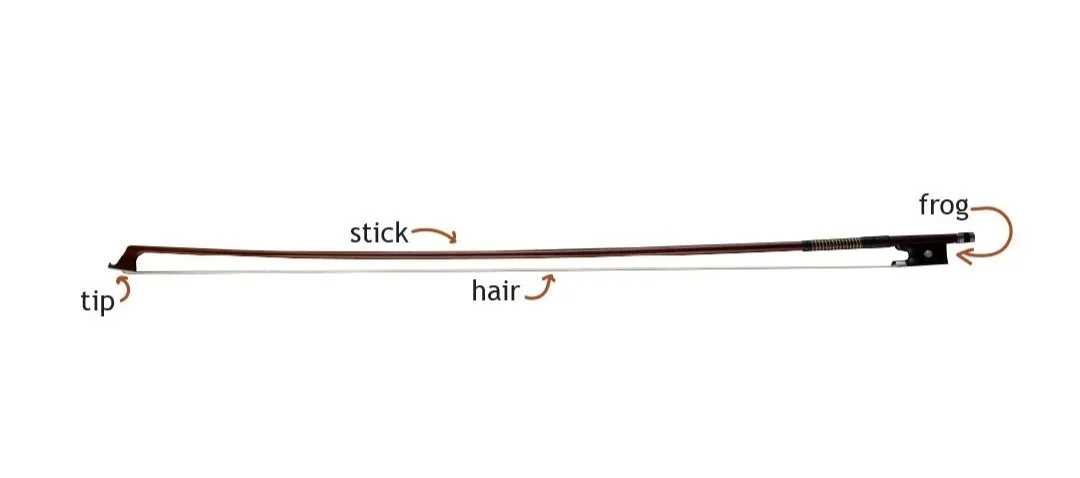
BOW:
Stick: Typically made of Pernambuco wood, the stick is long and cambered (like a ski).
Hair: Horsehair is stretched along the stick, used to draw sound from the strings. Horse Hair is coarse and holds rosin.
Frog: The handle of the bow, where the player holds it.
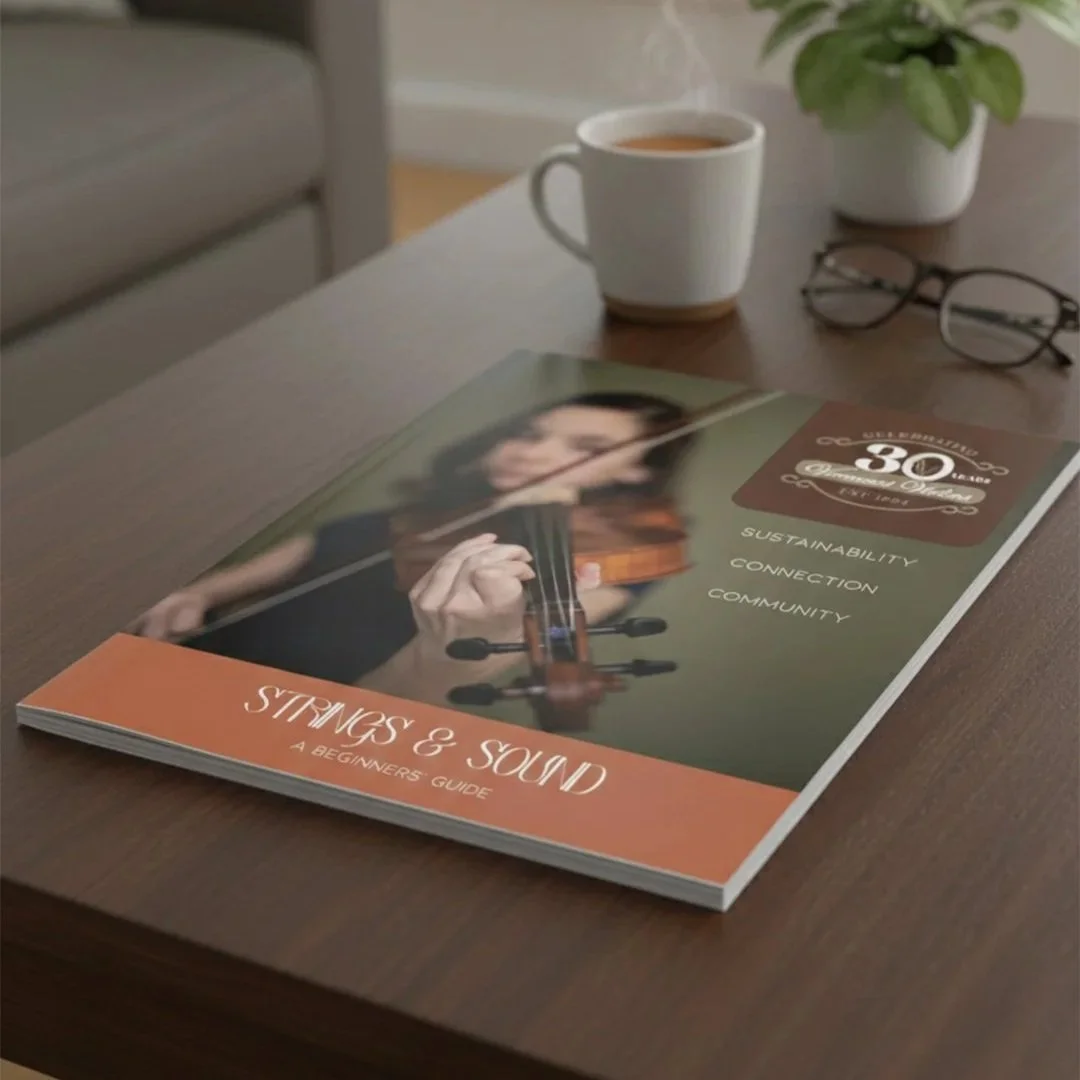
The String Parent’s Essential Guide: From First Note to Pro Care
Stop Guessing. Start Supporting. Is your child starting their journey with the violin or viola? While they focus on the notes, you have to focus on the "Particulars"—the sizing, the maintenance, the strings, and the gear. The String Parent’s Essential Guide is a 30-chapter deep dive designed specifically to turn "Music Parents" into "Expert Allies."
Why You Need This Guide:
The Anatomy of the Violin: Understand exactly what you are paying for and how the instrument works.
The Perfect Fit: Our comprehensive Sizing Guide ensures your child isn't struggling with an instrument that’s too big or too small.
Beginner’s Essentials: From choosing the right Rosin to selecting Strings and Cases, we take the guesswork out of the shop.
Instrument Longevity: Learn the "Instrument Wellness Check" and how Climate Change affects tonewood, saving you hundreds in avoidable repairs.
Expert Perspectives: Exclusive conversations with teachers like Kristina Turner and makers like Seth Kimmel provide professional insights you won't find on YouTube.
What’s Inside (30 Feature Chapters):
This magazine covers the full lifecycle of a student's early years, including:
Technical Basics: Tuning your instrument, unboxing, and safe storage.
The Big Decisions: Should you Rent or Purchase? We break down the math for you.
Education Methods: A deep dive into the Suzuki Method and conversations with Suzuki experts.
Advanced Knowledge: Learn about the history of the violin, the evolution of bow making, and the future of sustainability in lutherie.
Equip your child for success by equipping yourself with the knowledge to guide them.

Experience the artistry. Meticulously crafted from seasoned spruce and maple. This instrument boasts a rich, warm tone that's perfect for both students and aspiring musicians. The vibrant ruby red varnish, hand-applied for durability and beauty, makes this violin a true standout.
This violin is sold as an outfit, complete with case and bow!


The Phoenix is the more advanced braided carbon fiber bow from the Revelle line. The Phoenix has a clear and easy tonal projection that feels nimble in your hand as it balances power attack with delicate movement and response. Carbon fiber weave creates a beautiful patina and appearance.


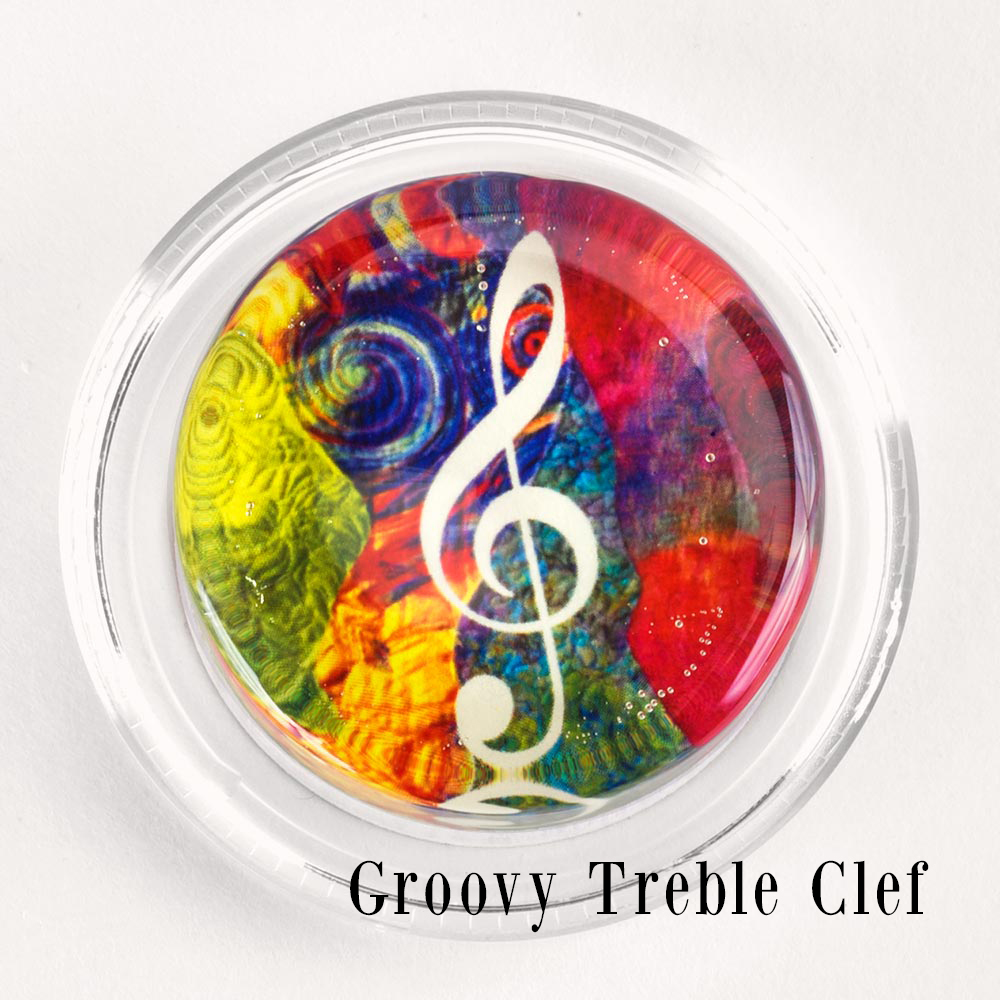


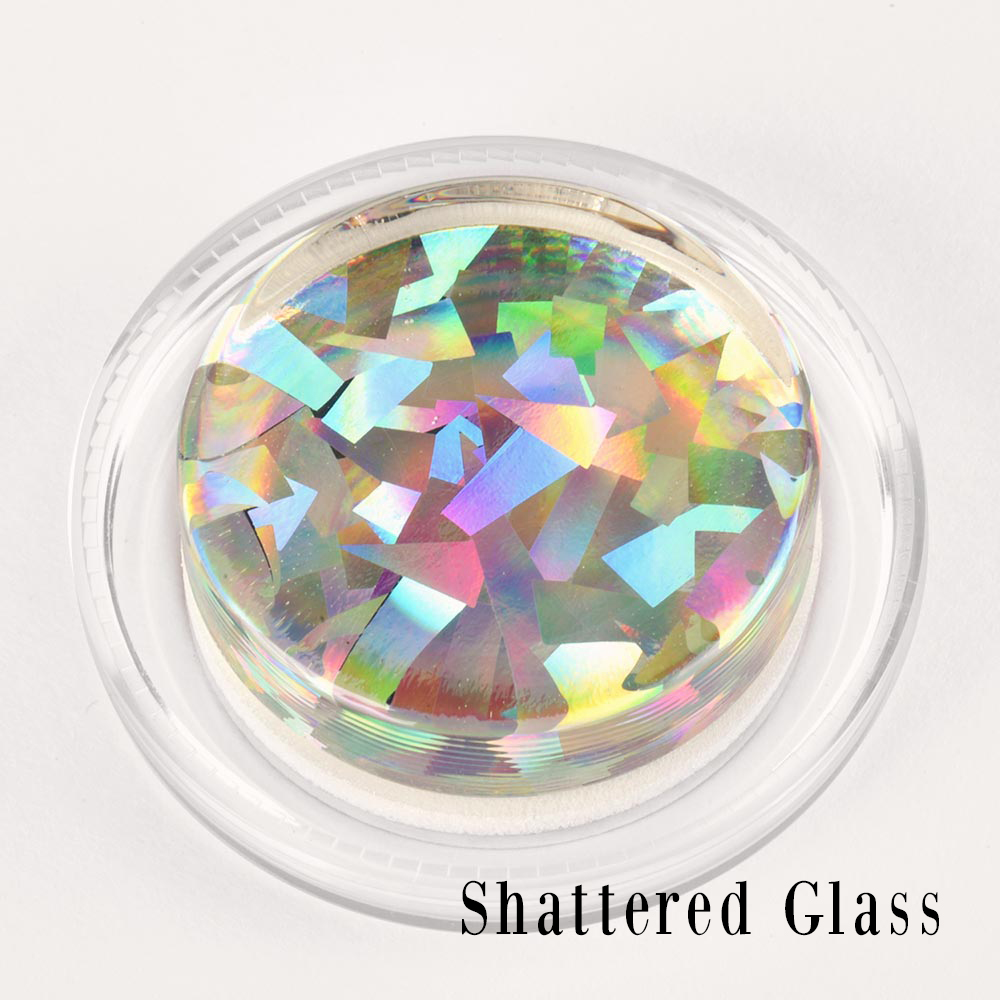









Magic Rosin® is a premium quality, professional-grade rosin that provides excellent grip and delivers a clear, complex tone. It is used by string players of all ages and ability, from soloists to students.
Simply Unique
Our special recipe uses only premium, purified pine resins. We avoid additives like oils, waxes, dyes, or metal fillings that are commonly used by rosin manufacturers.
Clearly Superior
Our production process yields rosin with a clear, glass-like appearance. We place designs underneath that transform each piece into a beautiful music-making tool with personality!
Customized for You
Magic Rosin is available in dozens of original designs or it can be customized with photos, logos, or artwork of your own. Players can choose from two formulas — 3G or Ultra:
3G is a grippy rosin designed for violin and viola
Ultra is grippier than 3G. We recommend it for cellists, bassists, or any advanced string player seeking more grip and “pop”
If you're unsure which formula to try, we suggest starting with 3G – string players tell us that it has more grip than most “light” (and even some “dark”) rosins that are widely used.
Less is More!
Because Magic Rosin has such excellent grip, you don’t need to use very much – 2-3 swipes across the entire bow is enough for most players. It also adheres to bow hair longer than most rosin — many players find they do not need to re-apply every time they practice.


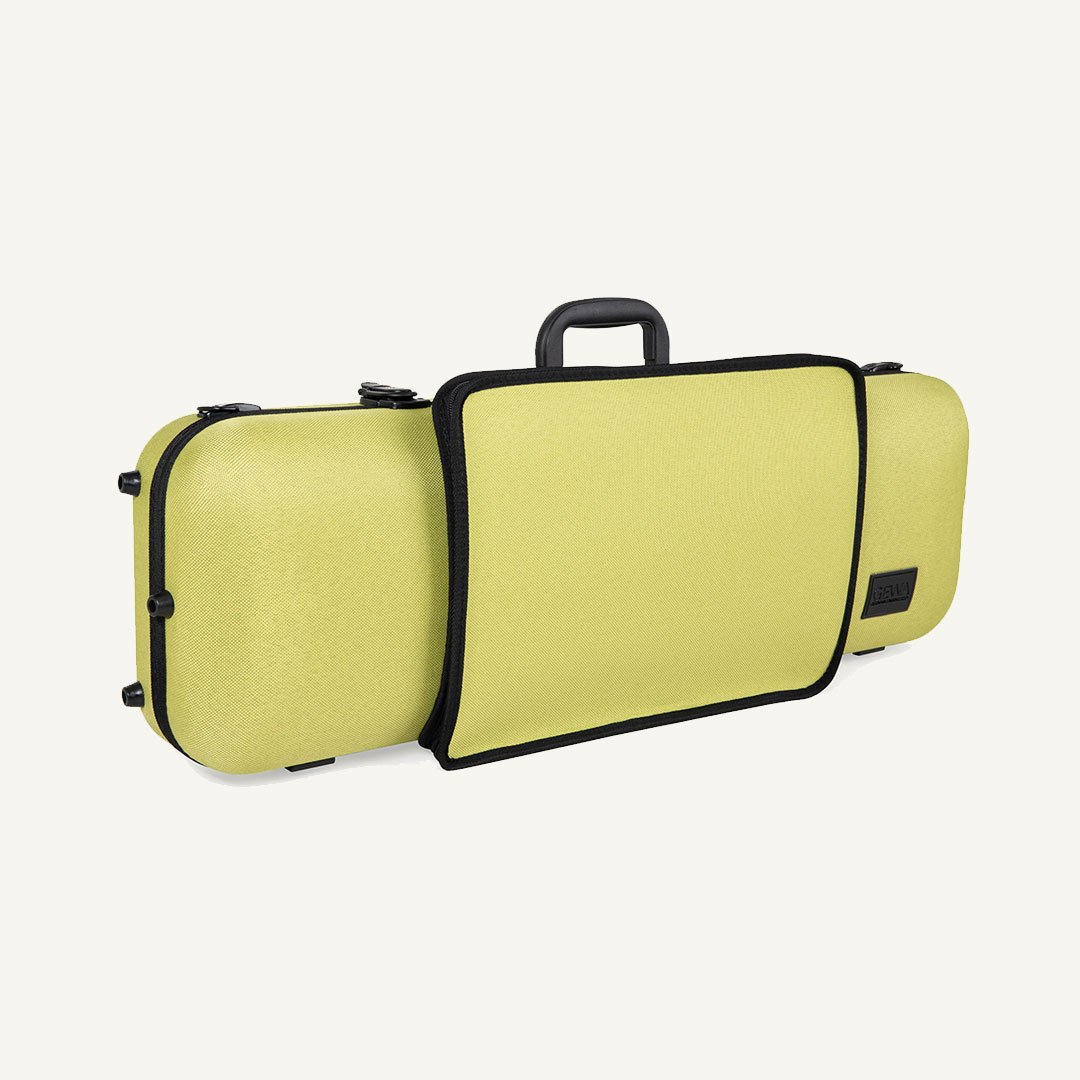


The Gewa Bio-A Violin Case - An environmentally-friendly case for your violin. Made from flax fiber sheets, lined and upholstered to create a renewable answer to case luxury. Only 2.8 kg. Available in four colors: Blue, lime, violet, and beige. Offers protection to both your violin...and the planet!
PROTECT YOUR VIOLIN. PROTECT THE PLANET.
There are very few moments in retail when a product genuinely surprises you — when something priced accessibly turns out to be thoughtfully engineered, responsibly made, and good enough that you actively want to tell people about it. The GEWA Bio-A Violin Case is one of those products. It is our clear recommendation for any violinist looking for the best violin case under $200, and it is a case we support not just because of what it does for your instrument, but because of what it stands for as an object.
Who Is the GEWA Bio-A For?
This case was designed for students, budget-conscious players, parents equipping a child for lessons, and musicians who prioritise environmental responsibility alongside practical performance. If you are searching for a well-made, fully functional violin case that does not demand a significant financial commitment — and that does not come at the planet's expense — the Bio-A is your answer.
The GEWA Credential
GEWA is a German manufacturer and one of the most respected case makers in the world. That heritage matters. A GEWA case is not an anonymous product; it is the output of a company with decades of engineering knowledge applied to the specific demands of string instrument protection. The Bio-A is simple, yes. But it is GEWA-simple — which means the latches work, the hinges hold, the suspension is properly engineered, and the overall construction meets a standard that genuinely protects what is inside.
The Organic Flax Shell: Why It Matters
The most distinctive feature of the Bio-A is its shell material. Rather than ABS plastic or fibreglass, this case is constructed from compressed organic flax fibre sheets, formed into a rigid, shaped shell. The result is a surface that looks and feels like a natural material — because it is — while delivering the structural rigidity required to protect a violin from real-world impact.
What makes flax fibre particularly compelling from an engineering standpoint is its strength-to-weight ratio. Flax is a natural composite — its fibres have excellent tensile strength and are naturally stiff when compressed into sheets — which is why flax-based materials have found applications in aerospace and automotive engineering in addition to instrument cases. The Bio-A shell is hard to the touch, not soft; it provides genuine impact resistance, not the cosmetic protection of a padded bag.
Approximately 90% of the Bio-A's construction is biodegradable. The metal hardware — hinges, latches, bow holder fittings — accounts for the non-biodegradable remainder, which is unavoidable in any functional case. But the shell itself, the material that gives this case its form and its protection, will return to the earth at the end of its useful life. For musicians who care about their environmental footprint, this is a meaningful distinction.
Suspension: Fully Suspended Interior
Despite its price point, the Bio-A offers a fully suspended interior — meaning the violin rests on cushioned supports rather than lying directly on the case floor. Suspension is the most important protective feature a case interior can offer. A suspended instrument absorbs vibration and shock through the cushions rather than through the instrument's body. At the Bio-A's price, this is not a given — it is a genuine differentiator and a reflection of GEWA's commitment to meaningful protection at every tier of their range.
The black velvet interior is clean, well-fitted, and padded to a standard that keeps the instrument securely positioned during transport.
The under-$200 violin case market is crowded with products that look functional in a photograph and disappoint in practice — cases where the latches stick, the suspension compresses on first use, or the hinges weaken within a season. The Bio-A sidesteps all of that because it comes from a manufacturer that builds cases the right way, regardless of the price tier. The open interior layout is intentionally simple — there is no elaborate shaped foam interior — but that spaciousness is a practical asset. It gives you room to carry a shoulder rest, rosin, strings, and accessories alongside your violin without crowding.
The Vermont Violins Verdict
We recommend the GEWA Bio-A to customers looking for an affordable, well-made case with a clear conscience. It is durable without being heavy, functional without being complicated, and eco-friendly without making any compromises that would give us pause. GEWA made this case right, and we are proud to carry it. If your budget is under $200 and you want a case that will genuinely protect your instrument — and that you can feel good about buying — the Bio-A is our answer.

Kindly be aware that the shipping cost applies solely to orders on the east coast. Our team will get in touch with you to discuss any extra shipping expenses that may be applicable to other locations.
SMS-30 Collapsible Music Stand
Carrying your music stand has never been easier. Our line of collapsing music stands feature a sturdy 5-panel desk that collapses after simply removing the sliding tray. Adjustments have been made a breeze thanks to our signature quick clamp levers, significantly cutting down assembly time. The stand compacts into an included carrying bag.
Height of 59" to the bottom of the desk
Tubular steel frame
Weight: 5.6 lbs
Included carry bag
Our Absolute Favorite Music Stand — And Here Is Why
Vermont Violins' specialists have a clear answer when students, parents, or teachers ask for a stand recommendation: the Peak SMS-30. It is not the cheapest stand we carry. It is the best — and the distinction matters.
The SMS-30 solves the central problem of portable music stands: most stands that fold small enough to carry have small, wire-frame desks that can barely hold a single sheet of music. Most stands with a full, solid desk are too heavy and awkward to transport regularly. The Peak SMS-30 eliminates that trade-off entirely.
The Clever Reveal: A Full Orchestral Desk in a Carry Bag
The defining feature of the SMS-30 is its full 5-panel desk — a solid, hinged desk surface comparable in size and stability to what you would find on a professional orchestral pit stand. When fully deployed, the SMS-30 presents a full platform capable of holding an orchestral score, a large piano reduction, or multiple pages of sheet music without wobble, sag, or page-drop.
What makes this remarkable is how it gets there. The desk rolls up when collapsed — a genuinely clever engineering solution that allows the full panel area to compress into a package that fits into the included carry bag. A student can carry it down a flight of stairs, across campus, or on public transit without difficulty. When it arrives at its destination, it sets up in seconds: release the quick clamp levers, extend the center column, deploy the desk panels, drop in the sliding tray, and you have a full orchestral-quality stand wherever you need one.
The removable sliding tray completes the picture — providing a ledge for accessories that can be detached when not needed, keeping the setup clean and functional.
Stability That Matches the Setup
A full desk is only useful if the stand beneath it can hold the load without tipping. The SMS-30 is built on a heavy-gauge tubular steel frame with a wide, secure tripod base — engineered to carry the weight of even the largest scores without wobbling. An optional center column extension is available for taller players, bringing the desk height to a range that accommodates standing adults comfortably — at 59 inches to the bottom of the desk at its standard configuration, it already serves most players in a standing position.
Available in both steel and lighter-weight frame options, the SMS-30 accommodates different priorities: the steel version is slightly heavier but provides a noticeably more planted, secure feel — our specialists note it is the version they prefer in the shop. For players prioritizing maximum portability, the lighter frame model reduces carry weight while maintaining the same desk quality and stability characteristics.
Who Is the Peak SMS-30 For?
This is the stand for the serious student who rehearses at school, practices at home, and performs in ensembles — and needs a stand that transitions across all three without compromise. For the string player who uses a full score or a large-format edition and needs a desk that will not drop their music mid-phrase. For the teacher who wants to recommend one stand that will last a student through their entire playing life. And for the adult amateur who is tired of cramped wire stands that barely hold a single page.
Vermont Violins considers the SMS-30 a staple. It is lightweight, easy to use, comes with its own carrying bag, and deploys a full orchestral-grade desk. It is, simply, the best stand at this price point.
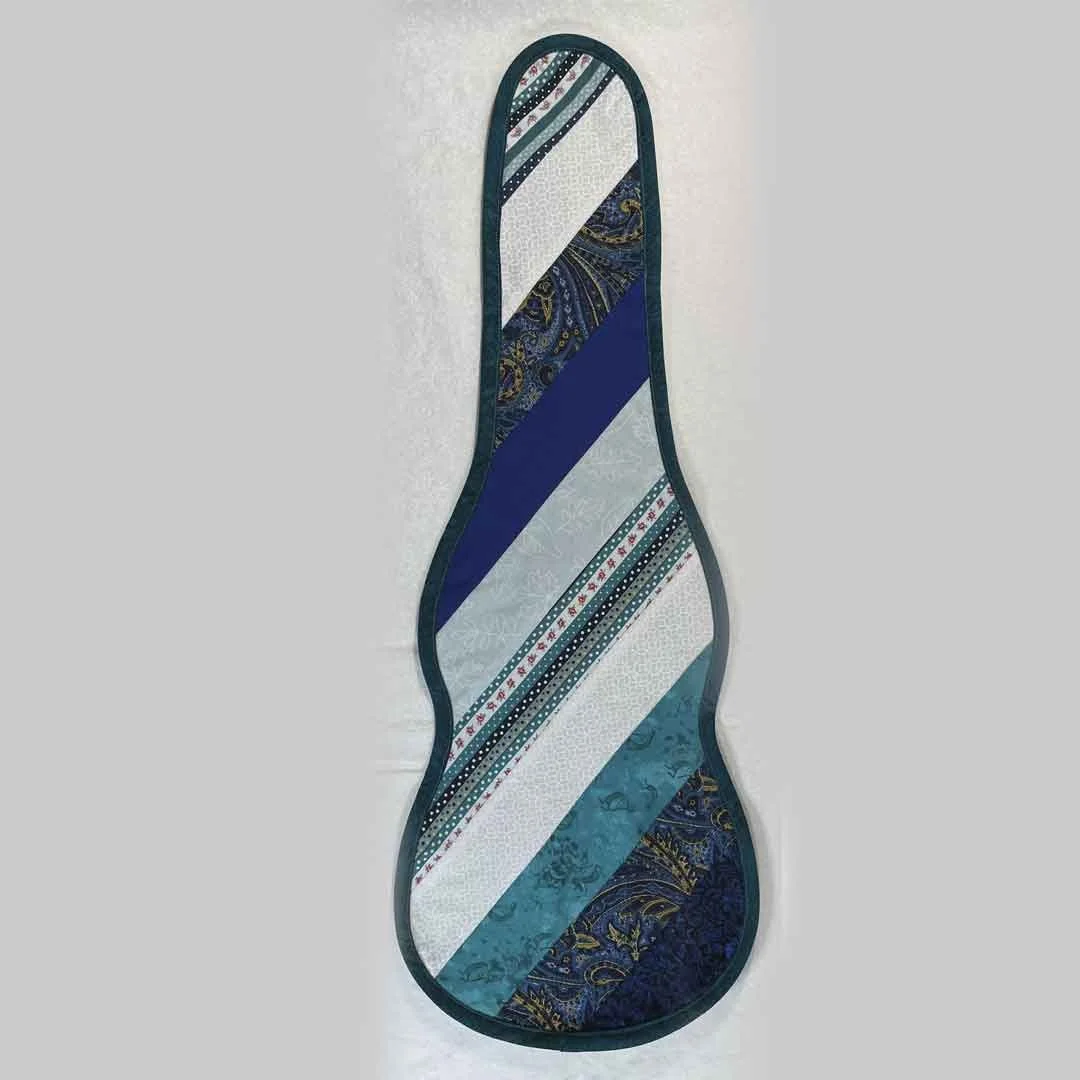
Give your violin or viola the gentle care it deserves with these sustainably handcrafted blankets from Green Star Playhouse. Made in Vermont from upcycled cottons, each blanket cushions your instrument perfectly in its case while adding artisan charm. Pre-washed and hot-iron tested to ensure no damage to delicate finishes, every blanket is truly one-of-a-kind. Perfect for safe storage between practice sessions or as a thoughtful gift for any musician who treasures their instrument. Hand wash recommended or gentle machine wash and dry.
Blanket Suitable for: 4/4 or ¾ Violin