
The Best Cello Humidity Control? Holly G. Tests Boveda for Cello
Humidity Control: the Goldilocks Principle
Holly G.
The day I turned in my rental cello and brought my own new cello home from Vermont Violins was a day of celebration! She was beautiful both visually and to the ear, and I vowed to do my best to keep her that way. But later that year, my beloved cello developed an alarming problem: the fingerboard separated from the neck. Back to Vermont Violins I went, containing my panic as best I could. The diagnosis was immediate and sure: my cello could easily be repaired, but excess summer humidity was the culprit. I was not about to let such damage happen again. My cello wanted humidity that was not too dry, not too wet, but just right. Goldilocks would have approved.
I learned about the Boveda humidity control system. It was initially developed to keep cigar humidors at the proper humidity, but now, in my own, strongly cigar-averse opinion – has a much higher calling keeping wood instruments happy in their cases. Each Boveda pack consists of a solution of salts thickened to a gel and enclosed in a semipermeable membrane that keeps the salts inside but allows water vapor to pass. These packs work on the principle that salts dissolved in water reduce the vapor pressure of the water. Water molecules are attracted to the salt particles, and this attraction makes it more difficult for the water molecules to leave the solution and evaporate into the air. Importantly, the degree to which salts do this can be closely controlled by varying the identity and concentration of the salt. There are many kinds of salts—common examples are sodium chloride and potassium chloride. I don’t know what salts are in the Boveda packs I use – they’re not saying – but those salts control the vapor pressure of the packs. If the packs are placed in a closed container like a cigar humidor, or more importantly, a cello case, they control the relative humidity in that container.
The Boveda company sells packs with different salt solutions in them that will keep the relative humidity in a closed container within appropriate bounds for a variety of applications. The packs I use for my cello are designed to maintain a relative humidity of about 49%. If the humidity gets too low, they release water; if it gets too high, they take up water to maintain that humidity.
The question: How well does it work?
I’d like to keep the relative humidity where I store my cello between 40 and 60%, but Boveda packs, like most everything, have limitations. It’s clear that a single Boveda pack couldn’t keep the humidity of a container the size of a football stadium constant, nor could it keep the relative humidity of my cello case constant indefinitely if the relative humidity in the room was too high or too low for a very long time. How well do the Boveda packs really work, and how many packs would be necessary to control relative humidity in my cello case for a reasonable amount of time, preferably months?
The test:
Before I could address these questions, I needed an inexpensive, accurate way to measure relative humidity in the room and in my case. I purchased four temperature/humidity sensors sold by Aik Tyree via Amazon for a few dollars each, but I had to wonder: at that price how accurate could these meters be? I already had a Stretto humidity sensor in my case; how accurate was it? To test the humidity sensors, I used solutions of different salts, each saturated with as much dissolved salt as it could hold. Saturated solutions have a known concentration and vapor pressure and they will establish a known relative humidity within a small, sealed container, so they can be used as standards to test the accuracy of meters. Using saturated solutions meant I didn’t have to weigh out salts carefully, just use enough salt that some remained undissolved even after a long time. Each meter was sealed in an 8 oz canning jar over saturated salt solutions to give the following known relative humidities: lithium chloride (11.3% relative humidity), magnesium chloride (33% relative humidity), sodium chloride (75.5% relative humidity) and potassium chloride (85.2% relative humidity). Data from each meter over each solution were taken over several days after the relative humidity stabalized in the jars.
The results were promising; all five meters (four Aik Tyree meters and the Stretto) showed a pattern similar to Figure 1. The meter readings (red) were within a few percent of theoretical relative humidity (black) over the mid-range, 33-85% relative humidity. At 11.3% relative humidity the meters overestimated relative humidity, by about 15%. I have no data for meter accuracy above 85% relative humidity, but readings did seem to become more erratic in that range, so readings at high relative humidity are suspect as well. Overall, these inexpensive meters are just fine within a range of relative humidity well beyond the 40-60% target range, and thus they were adequate to test the effectiveness of Bovida packs in my cello case.
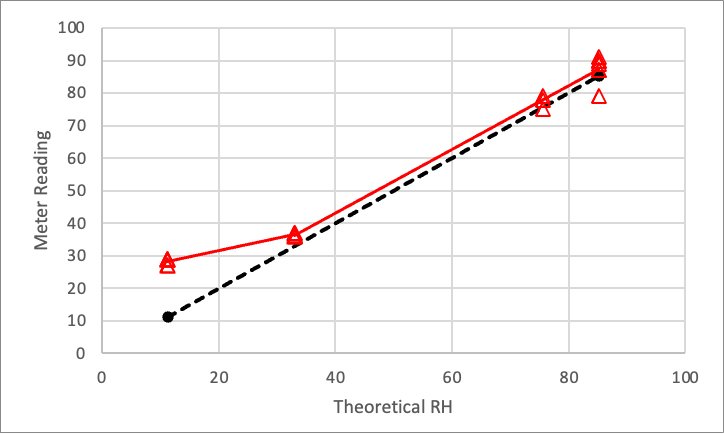
Figure 1. A perfect meter should give measurements that lie along the black, dashed line. The data in red came from one of the Aik Tyree meters; other meters gave similar results.
Boveda recommends using one 70g Boveda 49% relative humidity pack for a violin or viola case, and I believe Vermont Violins recommended that I’d need two for my cello case. However the volume of a cello case is much more than twice that of a violin case, so I ran tests with both 2 and 4 packs, recording relative humidity in my cello case (using the Stretto sensor) and in the room (using an average value from several of the small Aik Tyree sensors). I ran tests over three experimental periods, each lasting several months, between 2021 and 2023, recording data daily when possible (Figure 2).
It is clear that the Boveda packs increased relative humidity in the cello case when ambient humidity was low. Figure 2 shows data for four Boveda packs during the winter 2022-2023. (My informal observation was that two Boveda packs were not as effective as four, and neither was a Stretto humidifier, but I don’t have data on that.) The Boveda packs were also effective at reducing relative humidity in the cello case during humid summer and early fall days. Sometimes the relative humidity in the cello case crept up to 70%, but most of the high-humidity data (orange and green points in Figure 2) are for two Boveda packs in the case. It is likely that using four packs would make humidity regulation even better, and using four rather than two packs would also make them last longer.
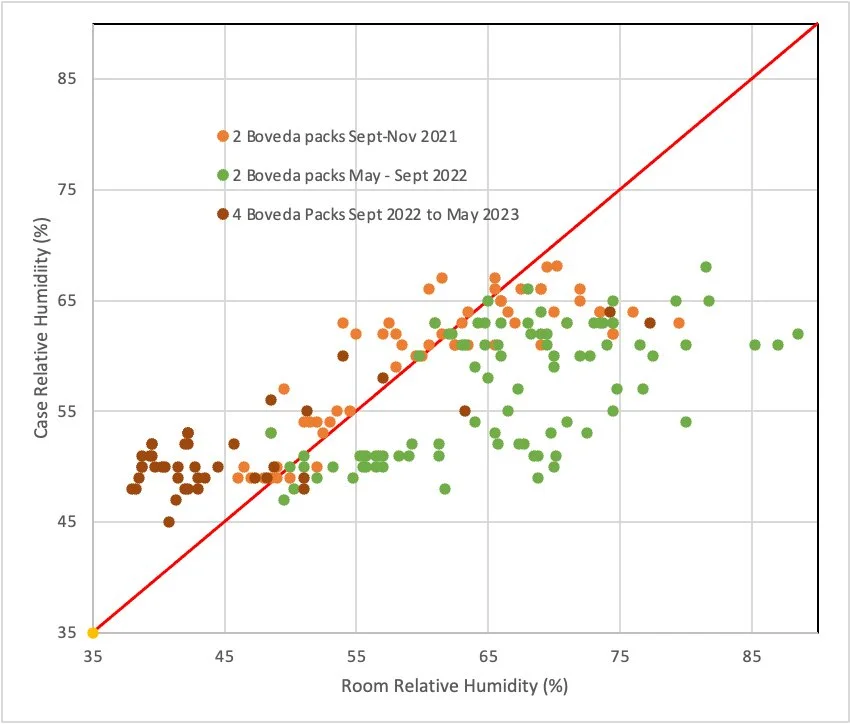
Figure 1. Effectiveness of two and four Boveda packs at controlling relative humidity in a cello case. The experimental periods included winter(purple), autumn (orange) and summer (green).
If the Boveda packs had no effect, the points would lie along the red line, and if they were perfect, the points would lie on a horizontal line at about 50% relative humidity.
Rejuvenating Boveda packs:
Although the Boveda packs are effective in controlling humidity, they have finite capacity to take up or release water so they must be replaced or rejuvenated periodically. Ideally, one could allow them to absorb water over the summer and then release that water over the winter, but it’s important to monitor the humidity in the instrument case and notice if the Boveda packs begin to lose effectiveness. The Boveda company recommends simply buying new packs and discarding the old ones when that happens, but it is possible to rejuvenate the packs and continue using them, and since I’m cheap and I prefer to reduce waste, that’s what I try to do.
Most commonly I need to rejuvenate Boveda packs in the winter when they dry out and can’t keep my cello case sufficiently humid: the relative humidity in the case begins to drop, the gel inside the pack begins to feel lumpy, and the packs weigh less because they have lost water. I weigh them with a kitchen scale. When new, the packs should weigh about 70 g and they work for both humidification and dehumidification. When they have lost capacity to release sufficient water, the packs can weigh about 60 - 65 g. I rejuvenate them by placing them in a single layer on a hardware-cloth screen over (not in!) water in a sealed plastic box. I monitor their weight increase daily as they absorb water from the humid atmosphere in the sealed box. I allow the packs to return at least to their initial, 70 g weight, and to 80 g or so if I’m only going to need humidification soon, not dehumidification. I don’t know if they could function in dehumidification at that weight, when they have already absorbed considerable water.
One can also rejuvenate packs that have taken up so much water that they are no longer effective at dehumidifying a case. I’ve dried them in the sun and breeze on a relatively dry summer day. Alternatively, one could try burying them in dry rice or putting them in a closed container with desiccant; little packages of desiccant are often included with a variety of products to protect them during storage and shipping.
The bottom line:
1. The Boveda packs worked well to control relative humidity in my cello case, both providing needed moisture in the dry winter and absorbing excess moisture in the humid summer, generally keep relative humidity between 40 and 60%.
2. The inexpensive combined temperature/humidity meters are sufficiently accurate for use in an instrument case, displaying values within a few percent of known relative humidity between 33 and 85%.
3. To make the Boveda packs last as long as possible, use an appropriate number for their size of your case. One could probably get by with two packs in a cello case, but I prefer to use four so they last longer and because together four packs have more capacity to counter extreme humidity or dryness. Leave the case closed as much as possible; those packs can’t control humidity in the whole state of Vermont! On days one must open the case multiple times daily during the humid summer, the packs have a hard time keeping up. Boveda now sells packs that are designed specifically for high-humidity use, but I have not tried them.
4. One can re-use the packs. I currently have two sets of four so I can always have one set ready for use when the other needs rejuvenation. The Boveda company might well disapprove, but I have been using some of my packs for four years and they still work well. For me, the initial investment of buying two sets of packs was justified because it is ultimately more economical and reduces waste.

In this video, Oren Kronick from Vermont Violins explains why proper humidification is essential for stringed instruments and demonstrates how the Boveda humidification system can protect your violin from costly damage.

Maintain Ideal Moisture Levels with Boveda for Wood Instruments
Automatically responds to any storage environment, geographic location or change in temperature
Adds or removes moisture on its own (eliminates messy sponges, hoses, discs, etc.)
Maintains a constant relative humidity (RH) between 40-60%—the ideal climate for wood instruments
Don't store your instrument without Boveda
There's a specific geometry built into your instrument. Precision crafted in a climate-controlled shop. An artisan used intense heat, moisture and pressure to bend wood to shape your instrument. Now the care and keeping of that wood is in your hands.
Developing and fine-tuning your repertoire put significant demands on your instrument. If you expose your instrument to humidity swings day after day, you can throw off its delicate alignment and cause permanent distortion. Improper storage is the greatest constant danger to the condition of any wooden instrument.
Storing your wooden instrument in a stable environment created by Boveda preserves your instrument, and maintains its sound, so you avoid taking repairs due to:
Cracking
Warping
Sagging
Glue damage
Boveda works automatically (& solo) — so there's nothing else to add
No more adding water to sponges, hoses, or discs. No more risk of moisture puddling inside your instrument. Boveda eliminates the hassle (and danger) of one-way humidification methods. These methods spike humidity when you add water, and take a nosedive as the water evaporates.
Boveda is pure water and natural salts sealed inside a leak-proof membrane. Boveda adds and absorbs water vapor slowly and precisely to achieve and maintain an RH level between 40% – 60% in your instrument’s closed case.
How to use Boveda
Just slip the unwrapped Boveda(s) in the pouch holder. (Do not open the Boveda itself.) Nestle the pouch holder in a storage cut-out in your case where the holder will not be crushed.
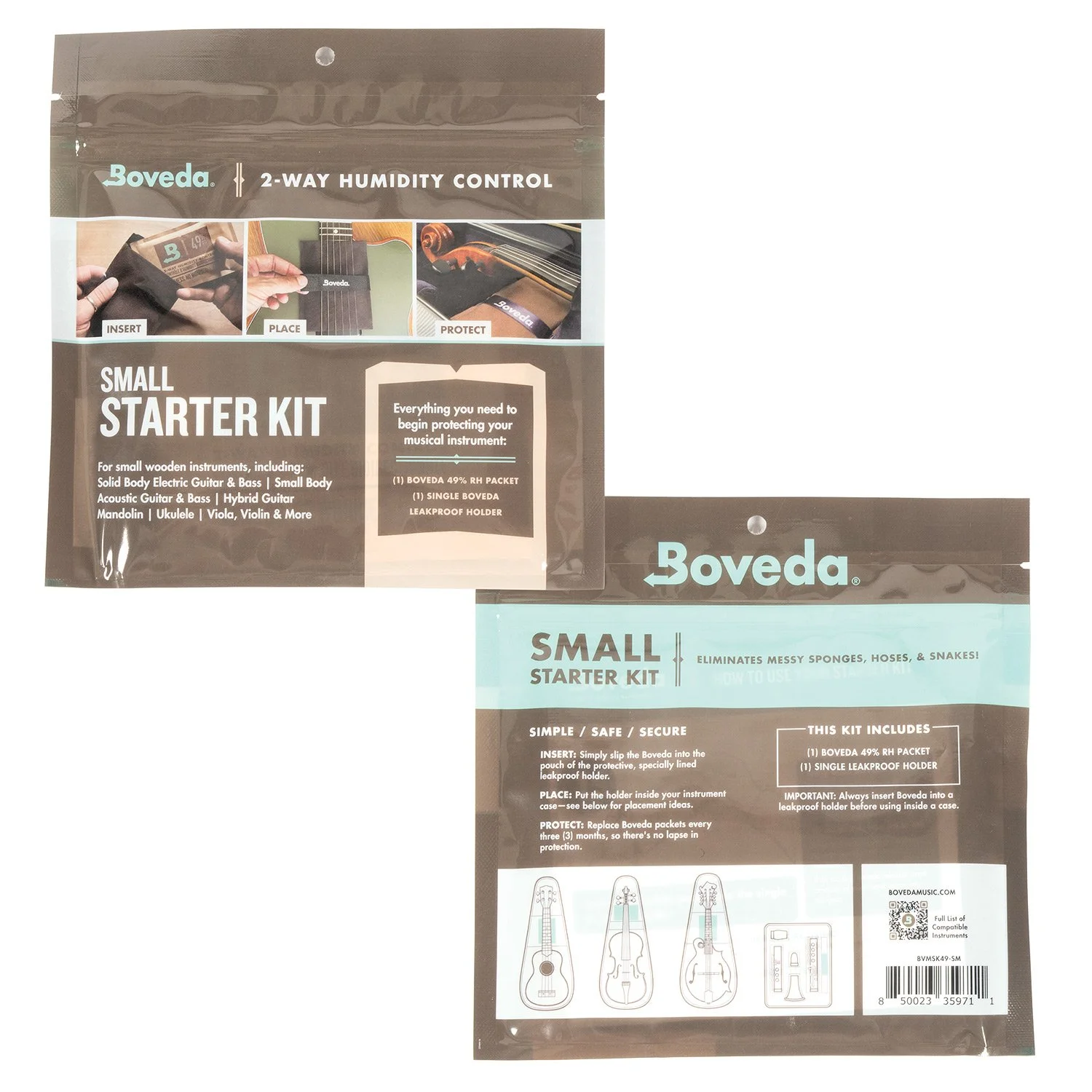
Boveda 2-Way Humidification Starter Kit for Small Instruments - Automatic Humidity Control
★★★★★5.0 Out of 5.0 - Overall Rating
Automatic 2-Way Humidity Protection for Your Valuable Instruments
The Boveda Small Instrument Humidity Control Starter Kit provides professional-grade protection for your violin, ukulele, mandolin, or other small wooden instruments. This intelligent 2-way humidification system automatically adds or removes moisture to maintain the ideal humidity zone, preventing costly damage from humidity fluctuations.
Unlike traditional one-way humidifiers, Boveda's patented technology both humidifies and dehumidifies, keeping your instrument in perfect condition for months without any maintenance. Simply place the leak-proof holder in your instrument case and forget about humidity worries.
Why Musicians Choose Boveda Humidity Control
Set-and-Forget Protection: Works automatically for months without refilling or monitoring
2-Way Technology: Adds or removes moisture as needed to maintain optimal humidity
Leak-Proof Design: Safe for use in any instrument case or gig bag
Prevents Damage: Protects against cracks, warping, and structural issues caused by humidity fluctuations
Complete Starter Kit: Includes everything you need to get started
Perfect for These Small Instruments
This small starter kit is specifically designed for:
Ukulele - Soprano, concert, and tenor ukuleles
Mandolin - All mandolin types and sizes
Violin - Student and professional violins
Viola - All viola sizes
Clarinet - Wooden and composite clarinets
Oboe - Professional and student oboes
Other Small Wooden Instruments - Piccolo, flute, and more
What's Included in Your Starter Kit
Each Boveda Small Humidification Starter Kit contains:
One (1) Single-Pouch Boveda Leakproof Holder - Durable, protective case for your humidity pack
One (1) Boveda Humidity Control Packet - Pre-calibrated to ideal humidity levels
Step-by-Step Instructions - Easy setup guide for immediate use
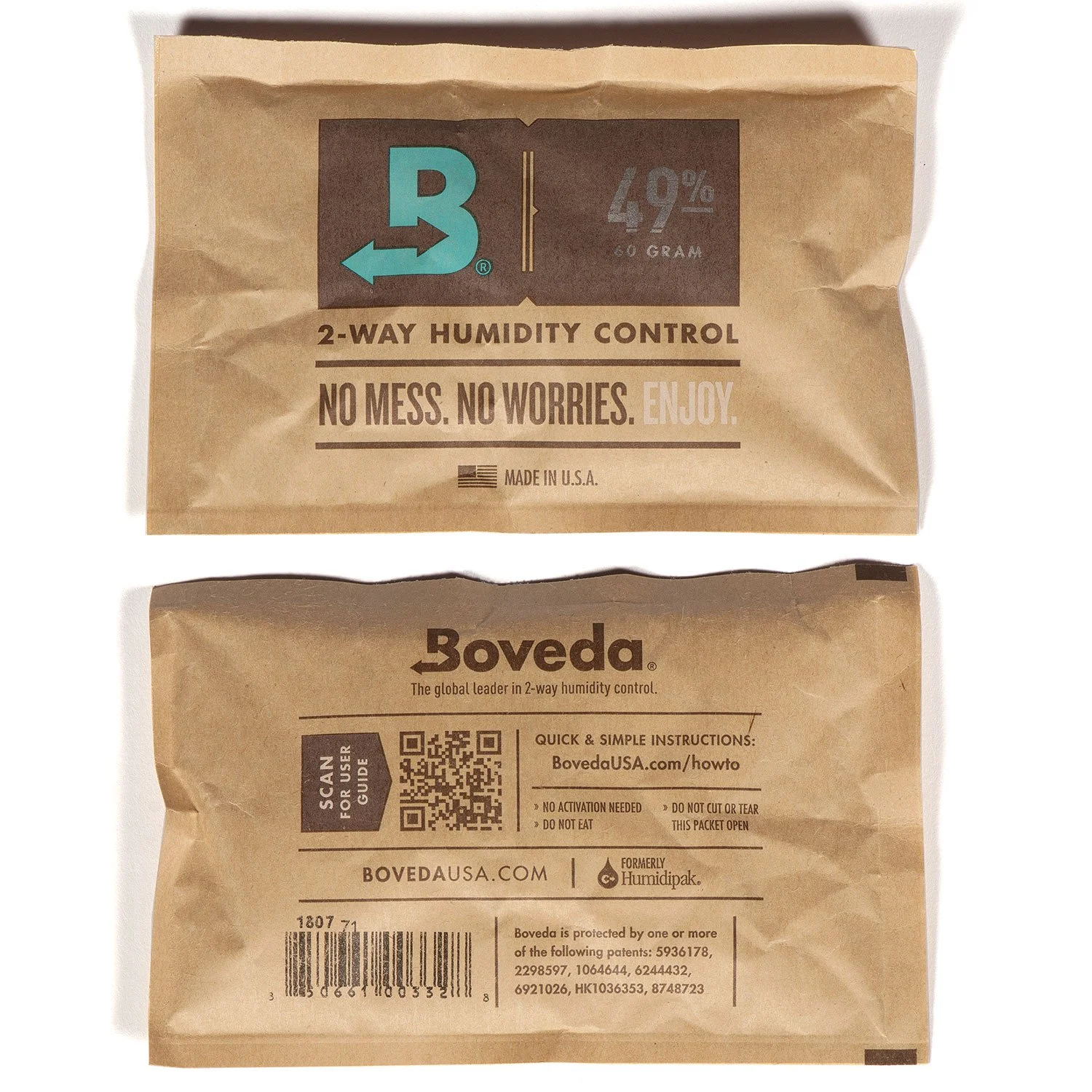
Replenish Your Boveda Humidifier with Refill Insert
The best humidifier/dehumidifier on the market. Carefully calibrated to offer the best protection for stringed instruments. Once set up in your case, no need to refill or recharge it….it will work on its own to maintain the proper humidity level of 49%. We recommend two per case for cellos, one per case for violin and viola. Do not use insert without the sleeve, sold separately. We find each insert lasts about 1-2 months in Vermont…it will last longer in less extreme climates.

Experience Hassle-Free Humidity Control with Boveda Sleeve
Boveda humidifier sleeve fits comfortably in your case and conveniently stores 1 Boveda humidifier pack.

Boveda 49% RH Replacement Packets for String Instruments - 70g, 12-Pack
Maintain optimal humidity protection for your violin, viola, or cello with Boveda 49% RH replacement packets. This 12-pack of 70-gram humidity control inserts provides a year's supply of two-way humidification to prevent cracks, warping, and costly instrument damage.
Premium Two-Way Humidity Control for String Instruments
Boveda is the industry-leading humidification solution for stringed instruments. Unlike traditional humidifiers that require constant refilling, Boveda packets automatically add or remove moisture to maintain a precise 49% relative humidity—the ideal level for violin family instruments.
Key Features:
12-pack bulk value: Cost-effective annual supply of replacement packets
70-gram capacity: Professional-grade humidity control
Precision calibrated to 49% RH for optimal string instrument protection
Zero maintenance: No refilling, recharging, or monitoring required
Two-way control: Both humidifies and dehumidifies automatically
Usage Recommendations by Instrument:
Violin & Viola: 1 packet per case
Cello: 2 packets per case
Average lifespan: 1-2 months in extreme climates (like Vermont); longer in moderate conditions
Important: Boveda replacement packets require a Boveda holder/sleeve (sold separately) for proper function.
Why Choose Boveda for String Instruments?
Professional musicians and luthiers trust Boveda to protect valuable instruments from:
Cracking and splitting from dry conditions
Seam separation and soundpost issues
Finish damage and warping
Seasonal humidity fluctuations
Set It and Forget It Protection
Simply place Boveda packets in their sleeves inside your instrument case. The patented technology does the rest—continuously monitoring and adjusting humidity levels with zero effort required.
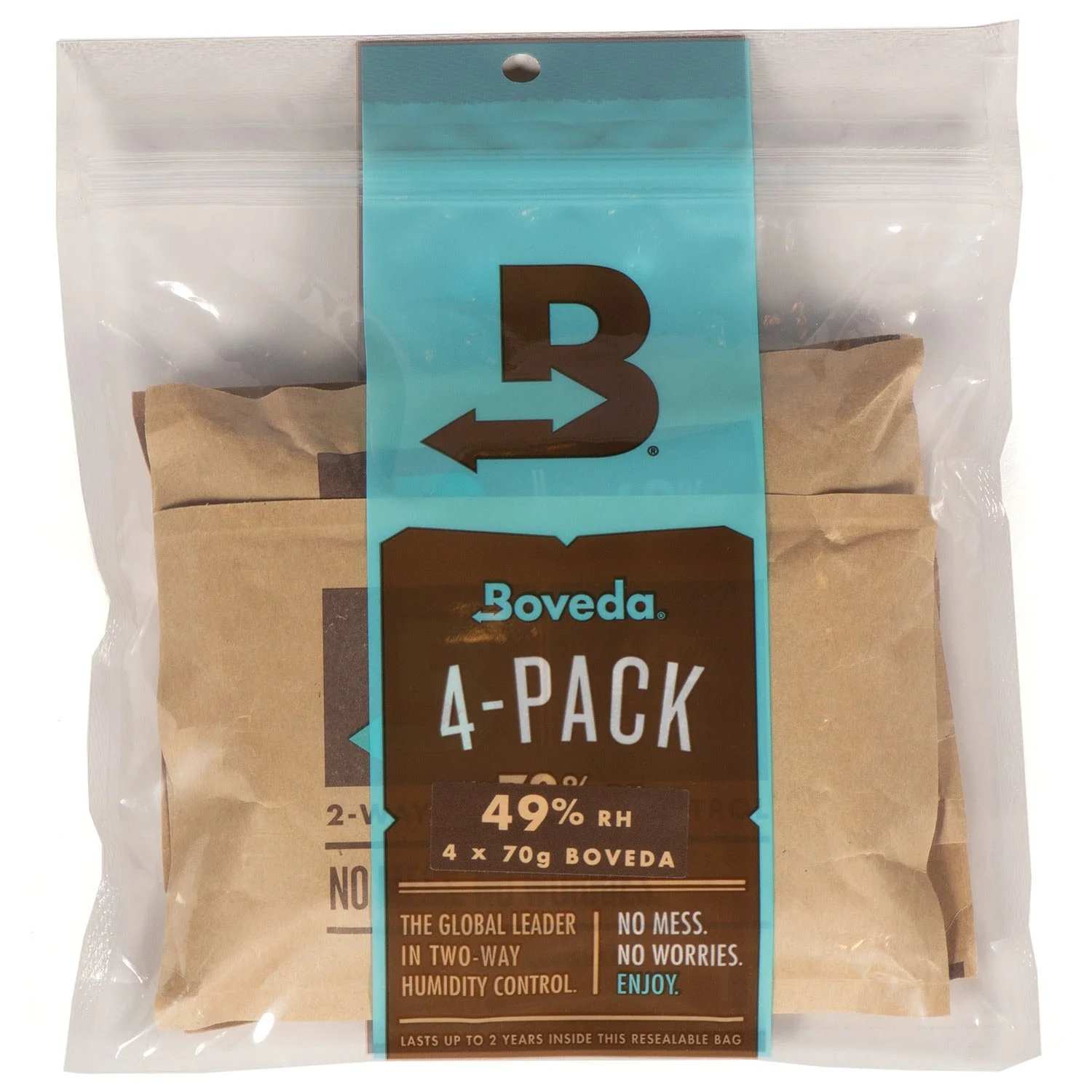
Boveda 49% RH Replacement Packets for Guitar Humidification - 70g, 4-Pack
Keep your guitar properly humidified with Boveda 49% RH replacement packets. Designed for acoustic guitars and wooden instruments, these 70-gram humidity control packets maintain optimal 45-55% relative humidity to protect your instrument from cracks, warping, and finish damage.
How Boveda Humidity Packs Work
Boveda packets feature a patented two-way humidity control system using pure water and natural salts encased in a water-vapor permeable membrane. This technology automatically adds or removes moisture to maintain precise humidity levels—no activation or maintenance required.
Key Features:
Precise humidity control: Maintains 45-55% RH (49% RH rated)
4-pack replacement packets - 70 grams each
Compatible with Boveda Guitar Humidification Kits and Wood Instrument Kits
Long-lasting: Typically 2-5 months per packet (varies by season, case quality, and ambient humidity)
Easy replacement indicator: Replace when packets become rigid
Perfect For:
Acoustic guitar humidification
Classical guitars
Wooden string instruments
Guitar case humidity control
Protect Your Investment
Proper humidity control is essential for maintaining your guitar's playability, tone, and structural integrity. Boveda replacement packets ensure continuous protection year-round.
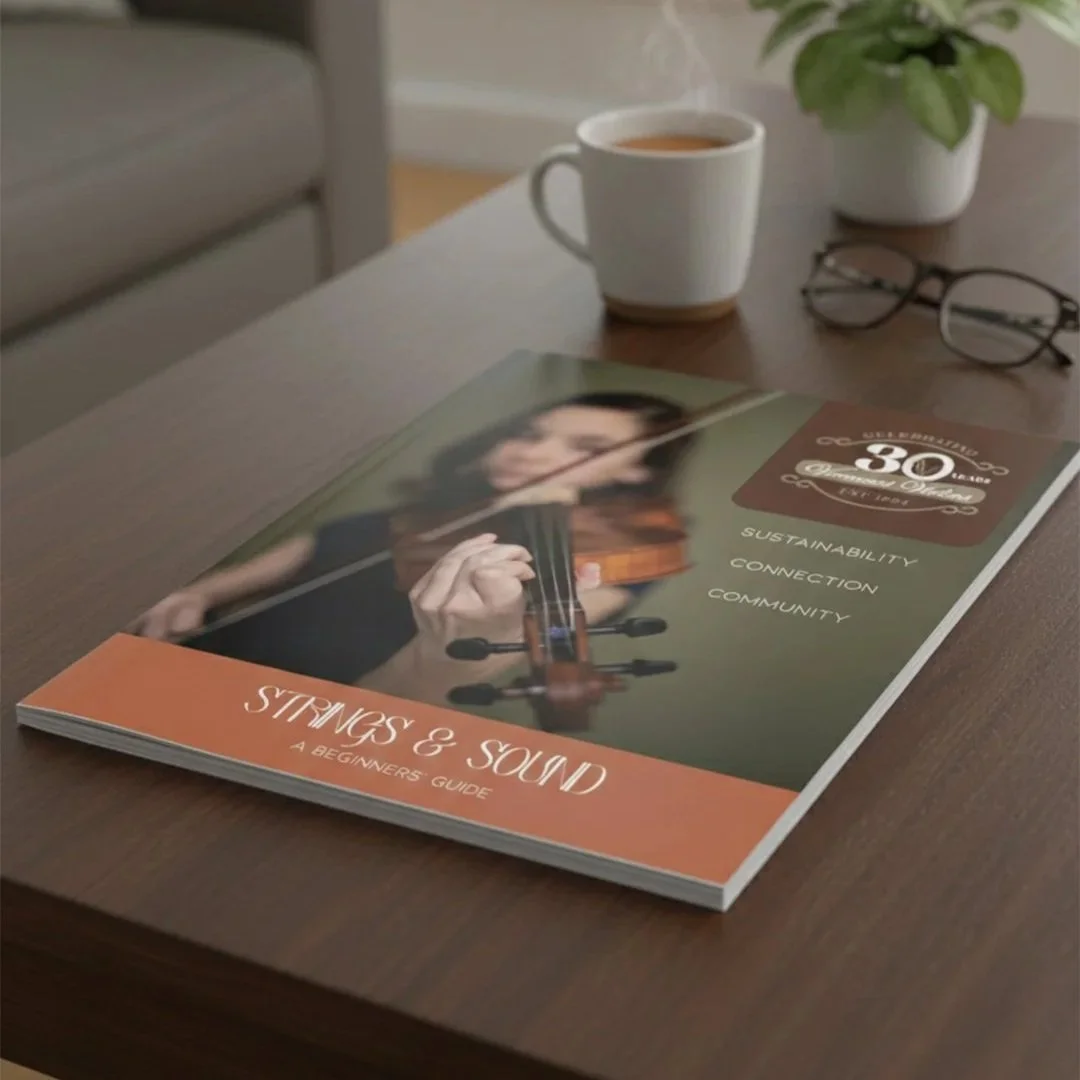
The String Parent’s Essential Guide: From First Note to Pro Care
Stop Guessing. Start Supporting. Is your child starting their journey with the violin or viola? While they focus on the notes, you have to focus on the "Particulars"—the sizing, the maintenance, the strings, and the gear. The String Parent’s Essential Guide is a 30-chapter deep dive designed specifically to turn "Music Parents" into "Expert Allies."
Why You Need This Guide:
The Anatomy of the Violin: Understand exactly what you are paying for and how the instrument works.
The Perfect Fit: Our comprehensive Sizing Guide ensures your child isn't struggling with an instrument that’s too big or too small.
Beginner’s Essentials: From choosing the right Rosin to selecting Strings and Cases, we take the guesswork out of the shop.
Instrument Longevity: Learn the "Instrument Wellness Check" and how Climate Change affects tonewood, saving you hundreds in avoidable repairs.
Expert Perspectives: Exclusive conversations with teachers like Kristina Turner and makers like Seth Kimmel provide professional insights you won't find on YouTube.
What’s Inside (30 Feature Chapters):
This magazine covers the full lifecycle of a student's early years, including:
Technical Basics: Tuning your instrument, unboxing, and safe storage.
The Big Decisions: Should you Rent or Purchase? We break down the math for you.
Education Methods: A deep dive into the Suzuki Method and conversations with Suzuki experts.
Advanced Knowledge: Learn about the history of the violin, the evolution of bow making, and the future of sustainability in lutherie.
Equip your child for success by equipping yourself with the knowledge to guide them.