
Tips On Safe Instrument Shipping
How Can I Safely Ship a Stringed Instrument?
Can Violins or Cellos be shipped safely? Absolutely. At Vermont Violins, we receive and ship instruments almost daily and in the many years we have been doing this, we have only seen damage twice and both times the damage was the fault of the packing. While twice is a very, very, very low number, we know how tragic this event can be so we wanted to share some instructions on how to pack an instrument safely so that it can land at its destination in the same condition as it left.
We are often asked which carrier to use. We have used all of the three large shipping carriers (and courier’s as well): UPS, USPS, Fed Ex and both ground and air services. All three provide excellent service with no damage and good tracking. Pricing and options, like Saturday delivery, can vary from carrier to carrier: comparison shop if you feel like it: they are all good! USPS is more limited for very large packages, like cellos. The others will charge steep oversize prices.
If traveling with your instrument is possible, check out our blog “How to Travel Safely with an Instrument” https://www.vermontviolins.com/faqs/2019/10/7/what-should-i-do-if-i-am-travelling-with-my-instrument-tips-for-shipping-and-safe-travels
As you plan your shipment, try to avoid weekend travel. Trucks, full of boxes, are often parked for the weekend and it can heat up quite a bit. During the summer months, we will plan most of our instrument shipments to go out on a Monday. If the violin is particularly valuable, we will opt for the more expensive air express services to get the package to its destination as quickly as possible.
To ship a violin, start by acquiring a sturdy box in excellent condition. Reused boxes are fine, but after a while boxes start to lose their structural integrity. Avoid boxes showing signs of crumpling or with rips and tears. The box should be of ample size to hold the instrument with plenty of room for cushioning packing materials (those annoying Styrofoam peanuts or air bags). Don’t skimp on the size of the box! And never ship an instrument just in its case with no box!
Ideally, instruments are shipped best unsetup. But this will likely result in the soundpost falling so you will need to hire a luthier at the destination to put the instrument back into playing condition…but travel is safer without the tension of the strings. To take down the strings: loosen the strings and release them from the tailpiece. Roll them up and tuck into the pegbox area. Put the bridge under the tailpiece (under the tuners) and wrap the tailpiece with paper. Also wrap the fingerboard. Ideally, you will also knock over the soundpost (use a business card and push it over through the f-hole…it will rattle around inside but cause no harm).
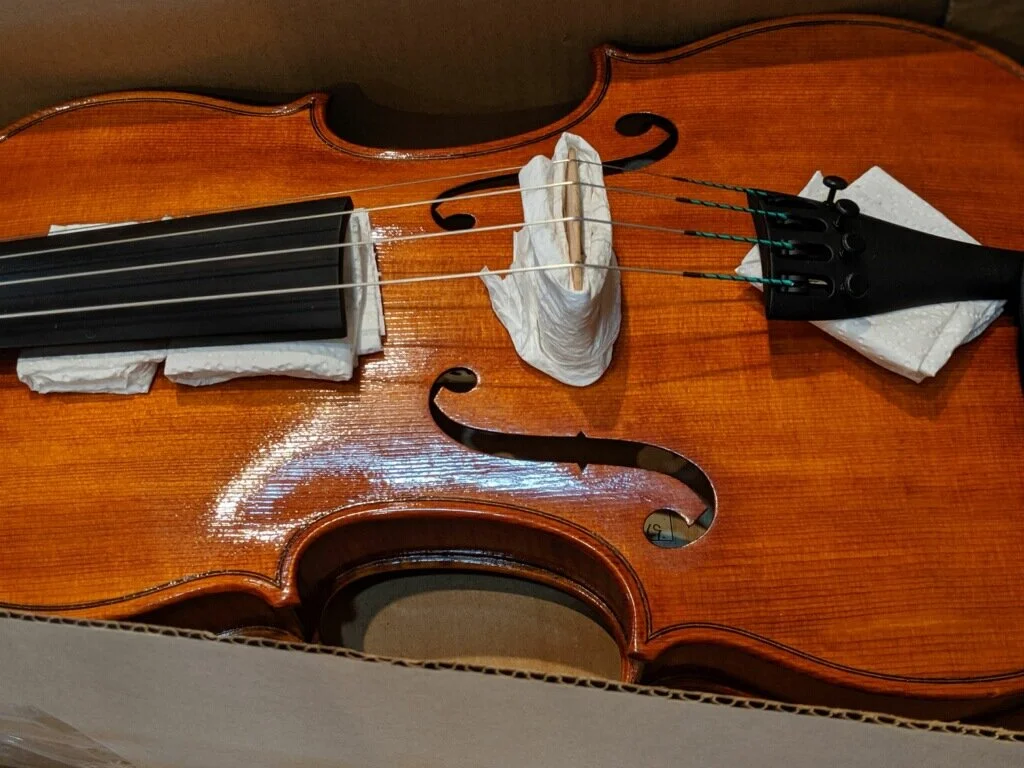
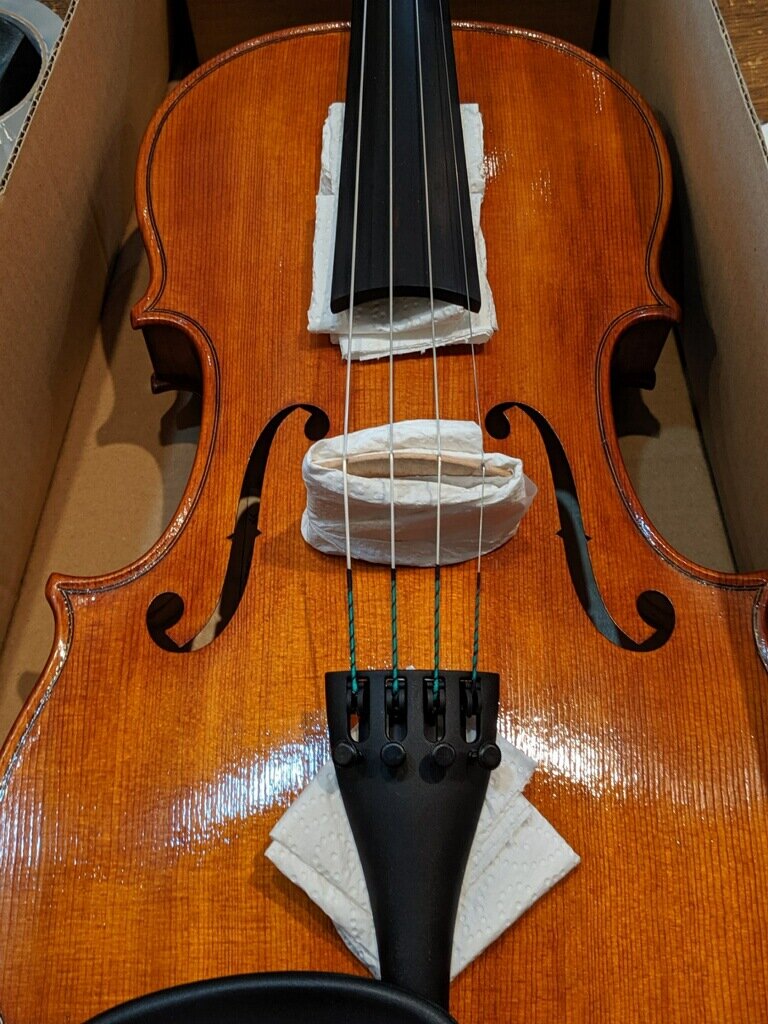
If you are shipping the instrument fully set up, you’ll need to take a few precautions as you pack her up. The illustrations refer to violins, but the same applies to violas and cellos as well.
First, drop the pitch about a quarter tone. You’ll need tension over the bridge to keep it in place, but full tension is not necessary. As you prepare the instrument, remember the most vulnerable part of the instrument is the neck: so you will want to fully support it. Fold a paper towel and put it under the neck so that it is firmly held up. Do the same for the tailpiece and wrap the bridge. With this, if the strings do release and the bridge falls, nothing will scratch the instrument.

Once wrapped, put the instrument inside the case. It is important that the instrument is snug in the case with no wobble. See the short videos: test to make sure that the instrument will not bounce around inside the case as it is handled by the carriers. If you are shipping in a case (better than cardboard boxes), it is best to have a case with full suspension pillows that hold the violin so that it does not sit on the bottom of the case. Most cases sold today are fully suspended, but there are plenty of older cases or less-expensive cases that do not have suspension pillows…..avoid these when shipping.
A blanket or other cloth on top of the instrument is also a good idea, especially if a bow is being shipped with the instrument. The bows occasionally fall off their spinners and “clunk” onto the top of the violin and as the box is moved about it can scratch. A blanket keeps the bow from falling onto the instrument…again preventing scratches, or worse.

Maintain Ideal Moisture Levels with Boveda for Wood Instruments
Automatically responds to any storage environment, geographic location or change in temperature
Adds or removes moisture on its own (eliminates messy sponges, hoses, discs, etc.)
Maintains a constant relative humidity (RH) between 40-60%—the ideal climate for wood instruments
Don't store your instrument without Boveda
There's a specific geometry built into your instrument. Precision crafted in a climate-controlled shop. An artisan used intense heat, moisture and pressure to bend wood to shape your instrument. Now the care and keeping of that wood is in your hands.
Developing and fine-tuning your repertoire put significant demands on your instrument. If you expose your instrument to humidity swings day after day, you can throw off its delicate alignment and cause permanent distortion. Improper storage is the greatest constant danger to the condition of any wooden instrument.
Storing your wooden instrument in a stable environment created by Boveda preserves your instrument, and maintains its sound, so you avoid taking repairs due to:
Cracking
Warping
Sagging
Glue damage
Boveda works automatically (& solo) — so there's nothing else to add
No more adding water to sponges, hoses, or discs. No more risk of moisture puddling inside your instrument. Boveda eliminates the hassle (and danger) of one-way humidification methods. These methods spike humidity when you add water, and take a nosedive as the water evaporates.
Boveda is pure water and natural salts sealed inside a leak-proof membrane. Boveda adds and absorbs water vapor slowly and precisely to achieve and maintain an RH level between 40% – 60% in your instrument’s closed case.
How to use Boveda
Just slip the unwrapped Boveda(s) in the pouch holder. (Do not open the Boveda itself.) Nestle the pouch holder in a storage cut-out in your case where the holder will not be crushed.
Once it’s all packed, you should throw in a humidifier device. We recommend the Boveda humidification system as it works as both humidifier and de-humidifier and does not relay on sponges that need to be constantly resoaked. This is especially important if you are sending your instrument off to locations with very different climates. Bovedas are inexpensive and very effective (and of course will be helpful for far more than just shipping).

The first of its kind by a leader of the instrument case industry: Bam France. This device fits easily into any instrument case and offers long-range protection and monitoring of your precious instrument. Using GPS and Cell technology, and in partnership with Votaphone, the Bam Instrument Tracker will let you know precisely where your violin is (in the case of theft, for example) and the humidity and temperature inside your instrument’s case. With the Gigs by Bam cellphone app, you can get notifications when your instrument’s humidity or temperature conditions hit threatening highs or lows! This device offers so much protection that many insurance companies are even giving discounts on their premiums to players who use it! The Gigs by Bam app has other great features too: it is designed to be a musician’s tool with chat, communication, scheduling functions!
Before you close the case, put your name and address on an index card and throw it inside the case. If you are shipping to us, be sure to tell us why you are shipping it: is it a rental return? A repair needed? A trial instrument coming back to us? You certainly want to make sure we can line up the instrument with your account and remember that most of our rentals look the same! Lastly, be sure there are no loose items just floating in the case. Tuners, spare strings, pitchpipes etc. should all be tucked away in the pockets. We recommend putting shoulder rests outside the case.
If you are shipping a particularly valuable (either financially or sentimentally) instrument, we recommend a GPS-based tracking device. Bam France offers an excellent option; it’s called “Gigs by Bam” and it allows you to track the whereabouts of your instrument using GPS. It also monitors the humidity and temperature inside the case which you can see on an associated online or cell phone app.
Close, latch and zip the case. The box you use should be large enough to offer about 3” of buffer space around the case. Fill the buffer with your packing material. Packing peanuts work well, but are uber-annoying to the person receiving (and are not very environmentally sound, unless you use the bio-degradable variety). We like the air-bag materials and bubble wrap is a favorite with kids!
Any additional items going with the violin should be taped to the case. Don’t throw loose items into the box; they are often thrown away unwittingly—especially if lost in a sea of peanuts!
Mark the outside of the box “Fragile” and with cellos put “This Side Up” pointing to the long seam above the bridge. It is best for the cello to travel flat on its back if possible.
If these precautions are met, your instrument is sure to land safely at its destination. These instructions are offered as tips and suggestions only and Vermont Violins is not responsible for any damage that does incur, even if these instructions are followed.