
REES HARPS


If you are interested in our long-term, interest-free, financing, please fill the form below
First select your harp!

Experience the Beauty of Nature with Rees Harps Aberdeen Meadows - A 36-String Harp for a Rich, Lush Sound and Stunning Floral Design!
The Rees Aberdeen Meadows Harp is the flagship of the Rees Concert Lever Harp line. It is made to project a large concert quality voice rich with subtlety and color. The light to medium string tension supports an extremely wide dynamic range allowing intention and interpretation to come to the fore. Unique to Rees Harps, this 36-string harp comes in two ranges, C to C and A to A. The two Aberdeens are the same size with the string tension of the C to C being very slightly more firm. Both Aberdeen Meadows Harps come with full Rees sharping levers. The Aberdeen also has a 3.5 (8.9cm) inch shoulder to allow comfortable play with a full range of motion. Depending upon wood selection this five octave harp weighs 25 to 27 pounds (11.4 to 12.5kg) and stands 55 inches (140cm) tall.
Like all Rees Concert Line Harps the Aberdeen comes with a tuning wrench, care sheet and a lifetime warranty.

The Rees Mariposa Concert Line Harp has the light weight and responsiveness prized by so many modern harpers. Luckily, the Mariposa does this without sacrificing any of the big voice and comprehensive dynamic range for which Rees harps are known. The Mariposa has a range of A to C and a string feel that is light but not so light it hides or distorts the voice. The Mariposa Harp comes with full Rees sharping levers and a narrow 3.5 inch (8.89 cm) shoulder that allows for complete freedom of movement. The Mariposa is 50 inches (127 cm) tall at the point and, depending upon the wood selected, weighs between 17 and 20 pounds (7.71 to 9.07 kg).
Like all Rees Concert Line Harps, the Mariposa includes a lifetime warranty.

The Rees Shaylee Meadows Concert Line Harp has an extraordinarily large and balanced voice for its size. This harp is a superb performance instrument for small venues, harp therapy and for those who love to play for their own enjoyment. The Shaylee Meadows Harp comes with full Rees sharping levers and a narrow 3.5 inch (8.89 cm) shoulder that allows you to move freely and easily while playing. The Shaylee Meadows is 46 inches (116.84 cm) tall at the point and, depending upon the wood selected, weighs between 16 and 18 pounds (7.26 to 8.16 kg).
Like all Rees Concert Line Harps, the Shaylee Meadows includes a lifetime warranty.
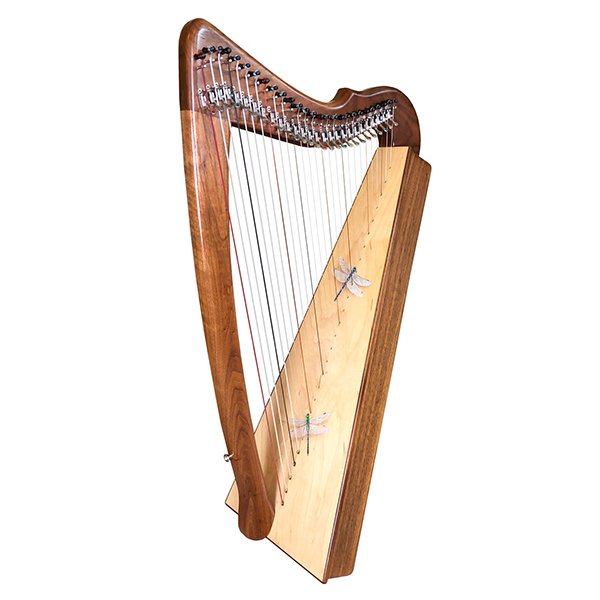
The Rees Morgan Meghan Concert Line Harp is a little big harp. This is a lap harp which competes favorably with many floor harps with a bold voice full of color. Like all Rees Concert Line Harps the voice of the Morgan Meghan is balanced and, unusual for a lap harp, the bass is open and deep. The Morgan Meghan Harp comes with full Rees sharping levers and harp pins. Depending upon the wood selected the Morgan Meghan weighs about 8 pounds (3.6 kg). The Morgan Meghan is 34 inches (86.4 cm) tall at the point.
Like all Rees Concert Line Harps, the Morgan Meghan includes a lifetime warranty.

The Rees Double Morgan Meghan Concert Line Harp is a little big harp. This is a lap harp which competes favorably with many floor harps with a bold voice full of color. Like all Rees Concert Line Harps the voice of the Double Morgan Meghan is balanced and, unusual for a lap harp, the bass is open and deep. The Double Morgan Meghan Harp comes with full Rees sharping levers and harp pins. Depending upon the wood selected the Double Morgan Meghan weighs about 11.5 pounds (5.21 kg). The Double Morgan Meghan is 34 inches (86.4 cm) tall at the point. Like all Rees Concert Line Harps, the Double Morgan Meghan includes a lifetime warranty.
NOW SELECT A BAG!

Please Note: Harp bags are available as add-on purchases only, when you buy a harp. We do not ship harp bags as standalone orders.
For those who plan to take their harps out and about our Rees padded harp bags are the perfect solution. The bags feature a long, adjustable padded strap, for carrying the harp on your shoulder, as well as double handles for hand carrying. Additional handles at the foot, point and on the pocket side make loading the harp into your car considerably easier. There is also a large zippered pocket to accommodate your chromatic tuner, tuning wrench and other gig supplies. Extra padding inside the bag protects the wood of the harp pillar from the zipper of the bag. These truly top quality bags are handmade in America.
We should note that we do not consider these bags to be sufficient protection for a harp to be checked as luggage aboard an airplane.
Please Note: Harp bags are available as add-on purchases only, when you buy a harp. We do not ship harp bags as standalone orders.
For those who plan to take their harps out and about our Rees padded harp bags are the perfect solution. The bags feature a long, adjustable padded strap, for carrying the harp on your shoulder, as well as double handles for hand carrying. Additional handles at the foot, point and on the pocket side make loading the harp into your car considerably easier. There is also a large zippered pocket to accommodate your chromatic tuner, tuning wrench and other gig supplies. Extra padding inside the bag protects the wood of the harp pillar from the zipper of the bag. These truly top quality bags are handmade in America.
We should note that we do not consider these bags to be sufficient protection for a harp to be checked as luggage aboard an airplane.
Please Note: Harp bags are available as add-on purchases only, when you buy a harp. We do not ship harp bags as standalone orders.
For those who plan to take their harps out and about our Rees padded harp bags are the perfect solution. The bags feature a long, adjustable padded strap, for carrying the harp on your shoulder, as well as double handles for hand carrying. Additional handles at the foot, point and on the pocket side make loading the harp into your car considerably easier. There is also a large zippered pocket to accommodate your chromatic tuner, tuning wrench and other gig supplies. Extra padding inside the bag protects the wood of the harp pillar from the zipper of the bag. These truly top quality bags are handmade in America.
We should note that we do not consider these bags to be sufficient protection for a harp to be checked as luggage aboard an airplane.
Please Note: Harp bags are available as add-on purchases only, when you buy a harp. We do not ship harp bags as standalone orders.
For those who plan to take their harps out and about our Rees padded harp bags are the perfect solution. The bags feature a long, adjustable padded strap, for carrying the harp on your shoulder, as well as double handles for hand carrying. Additional handles at the foot, point and on the pocket side make loading the harp into your car considerably easier. There is also a large zippered pocket to accommodate your chromatic tuner, tuning wrench and other gig supplies. Extra padding inside the bag protects the wood of the harp pillar from the zipper of the bag. These truly top quality bags are handmade in America.
We should note that we do not consider these bags to be sufficient protection for a harp to be checked as luggage aboard an airplane.

Some people have a difficult time holding a lap harp between their knees so we have designed a simple solution to assist these folks which adds both comfort and security. The Rees Harp Stick has two parts, one which fits into the lower soundhole at the back of your lap harp and the other, which stays external to your harp, rests across your knees. The Rees Harp Stick is extremely easy to install and remove. It is available in walnut or cherry to match your Morgan Meadows, Morgan Meghan, Kelty Meadows or Kerrick Meadows Rees Concert Line Harp.
Note: The lap stick is recommended with the Morgan Meghan only
To see the Rees Harp Stick being installed take a look at this video.

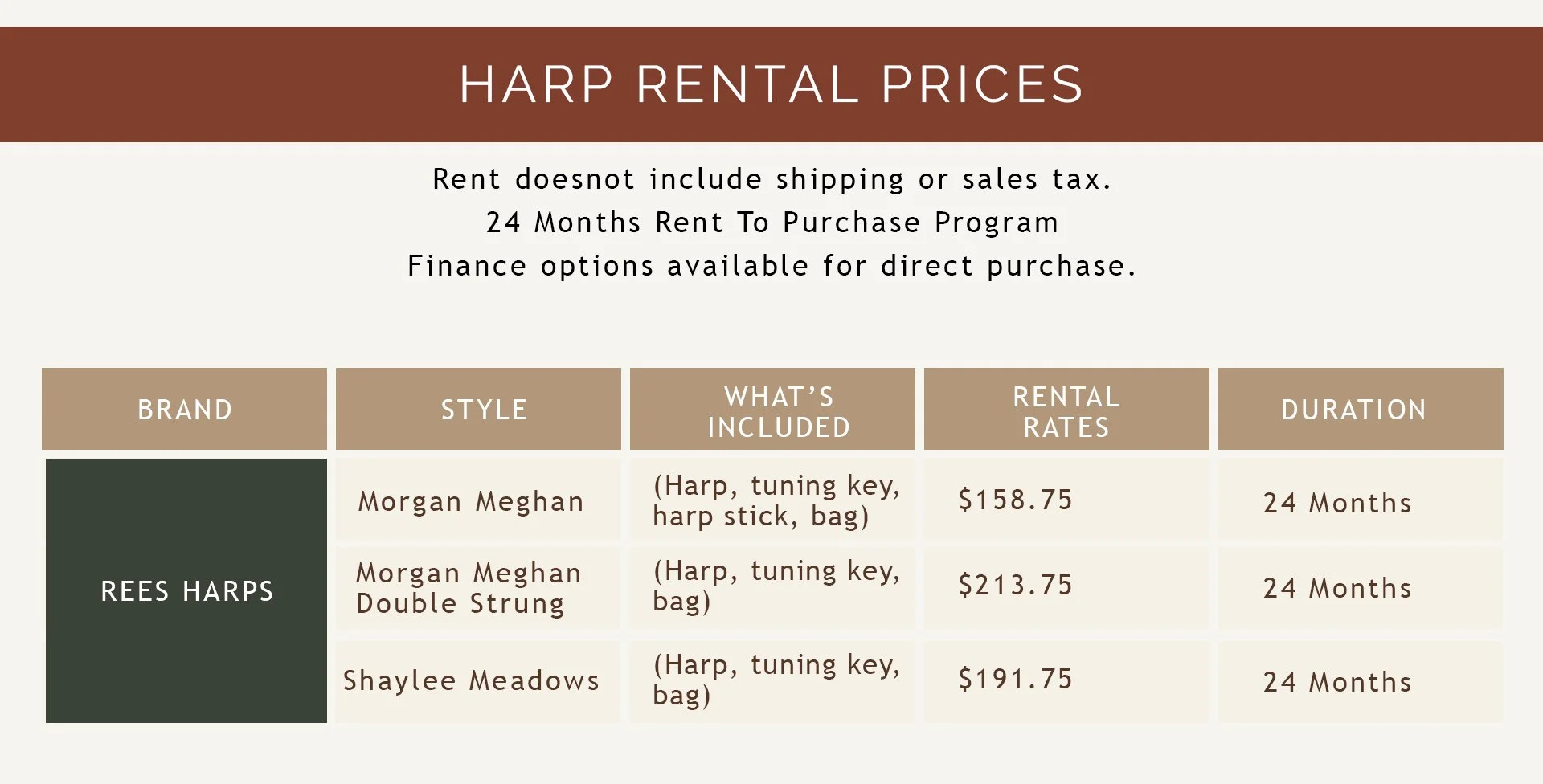
BENEFITS OF THE HARP RENTAL PROGRAM BY VERMONT VIOLINS
Pay only the first month’s rent and delivery upfront.
No security deposit.
Ownership after 24 months
Stop anytime…or buy out early and save!
American-Made Concert Harps with a Lifetime of Sound
Rees Harps has been building instruments in the United States since 1972 — a continuous tradition of American lutherie that now spans more than fifty years, three generations of family involvement, and a global reputation for professional lever harps that are as sonorous and responsive as any in their class.
William Rees began as a hobbyist luthier in a California garage while teaching high school science. His instruments earned a reputation that grew faster than his garage could contain. By 1992, building had become his full-time work. By 2000, Rees Harps had relocated to Rising Sun, Indiana — a 7,000 square foot facility purpose-built for harp manufacture, where the Concert Line harps are still made today, by a small, dedicated team, to standards that have not changed since the beginning.
Vermont Violins was among the first harp centers in the region to carry Rees Concert Line harps — and we carry them because our teachers asked us to. Specifically: the most prominent harp teachers in Vermont and New Hampshire, the instructors whose students come to us, consistently pointed their students toward Rees instruments. They trusted the consistency, the lifetime warranty, and most of all the sound. We listened, and we have stocked the Rees Concert Line ever since.
The Engineering Difference: Asymmetric Soundboard
Every Rees Concert Line harp incorporates an asymmetric soundboard — a design principle borrowed from violin making. The bass and treble sides of the soundboard are engineered with different thicknesses and stiffness gradients to respond optimally to the distinct acoustic demands of each register. Bass strings require more soundboard compliance; treble strings require more stiffness and resistance.
The result is a harp with a notably even, balanced voice across its full range — one that allows intention and interpretation to come forward, rather than requiring the player to compensate for register inconsistencies. When you compare a Rees Concert harp against comparable instruments at similar price points, the balance is the first thing experienced players notice.
All Rees Concert Line harps come with full Rees sharping levers installed, a tuning wrench, a care sheet, and a lifetime warranty — an assurance of build quality that Rees backs unconditionally.
The Rees Concert Line at Vermont Violins
Aberdeen Meadows (36 strings, $5,800) — The flagship of the Rees Concert Line. Standing 55 inches tall and weighing 25–27 lbs depending on wood selection, the Aberdeen projects a large concert-quality voice with extraordinary subtlety and dynamic range. Available in both C-to-C and A-to-A ranges — the same physical instrument with slightly different string tension characteristics. Five wood options: Cherry, Walnut, Maple, Cherry/Maple, and Walnut/Maple. The Aberdeen is the Rees instrument for the player who wants everything.
Mariposa (34 strings, $5,300) — The lightest and most responsive Concert harp, at 17–20 lbs. The Mariposa prioritizes the qualities modern harpers most prize: light weight and fast response, without sacrificing the big voice and comprehensive dynamic range for which Rees harps are known. Range: A to C. Preferred by players who perform frequently and value portability at a concert level.
Shaylee Meadows (30 strings, $3,400) — An extraordinarily large voice for its size. At 46 inches tall and 16–18 lbs, the Shaylee is the Concert Line harp for the player who wants a performance instrument for small venues, therapy settings, and personal playing — without the footprint of the Aberdeen or Mariposa. It punches significantly above its size.
Morgan Meghan (27 strings, $2,800) — Rees describes this as "a little big harp," and the description is accurate. The Morgan Meghan is a lap harp that competes favorably with many floor harps in voice, with an open and deep bass unusual in an instrument of its dimensions. At approximately 8 lbs and 34 inches tall, it is the most portable instrument in the Concert Line. Also available in a Double Strung configuration ($3,900) for players who require chromatic playing capability.
Beautiful, Sonorous, Built for a Lifetime
The professional harps at Vermont Violins are chosen because they represent an investment worth making. Rees Concert Line harps, in our specialists' direct experience, produce a sonorous, uplifted tone that rewards serious playing for a lifetime. They are built from beautiful tonal hardwoods — Cherry, Walnut, Maple — chosen and finished to bring out the natural voice of the material and the visual warmth of the grain.
They are also instruments with a particular resonance in settings beyond the concert stage. Harp therapists — players who work in hospitals, hospices, and care environments — frequently choose Rees harps because the instruments are portable enough to carry without logistics, quiet enough for intimate spaces, and powerful enough to fill a room when called upon. The Shaylee Meadows and Morgan Meghan are especially popular in this context.
Wood Selection: What to Know
Every Rees Concert Line harp is available in multiple solid hardwood species. Here is how to think about the choice:
Cherry — Warm reddish-brown; the most popular choice. Cherry ages beautifully, deepening in color over years of playing and exposure to light. Tonally warm with an open midrange.
Walnut — Rich dark chocolate brown with deep figuring. Slightly denser than cherry, contributing to a fuller bass response and a slightly more powerful overall voice.
Maple — Bright, light-colored grain with a crisp, clear tonal character. The most reflective acoustic choice.
Cherry/Maple or Walnut/Maple — Mixed-species construction combining the tonal and visual characteristics of both woods. Popular for players who want visual distinction and a blended acoustic character.
FAQ — People Also Ask
Are Rees harps good quality?
Yes. Rees Harps has been building lever harps in the United States since 1972 and is considered one of the finest American harp makers. The Concert Line instruments are used by professional harpists worldwide and carry a lifetime warranty.
Where are Rees harps made?
Rees harps are made in Rising Sun, Indiana, USA, in a purpose-built lutherie facility by a small team of dedicated craftspeople.
What is the difference between a Rees Concert harp and a Harpsicle®?
Rees Concert harps (Aberdeen, Mariposa, Shaylee, Morgan Meghan) are solid hardwood instruments with full-sized range and professional-grade voice. Harpsicle® harps are lighter, more portable instruments with a smaller range, designed for beginners, therapy, and travel. Both are made by Rees Harps.
Do Rees harps come with levers?
Yes. All Rees Concert Line harps come with full Rees sharping levers installed on every string.
Is there a warranty on Rees harps?
Yes. All Rees Concert Line harps carry a lifetime warranty.
Can I rent a Rees harp from Vermont Violins?
Yes. Vermont Violins offers a 24-month Rent-With-Ownership program for Rees Concert Line harps. You pay only the first month's rent and delivery upfront, with no security deposit, and ownership transfers after 24 months.
What is the lightest Rees Concert harp?
The Morgan Meghan, at approximately 8 lbs. The Mariposa, at 17–20 lbs, is the lightest full Concert floor harp in the line.
ABOUT: REES HARPS
Luthier William Rees began selling harps in 1972. At that time he was living in California, teaching high school science, gigging with a band on weekends and starting a family. Building stringed instruments was something he did as a hobby and to add some income. Everything he built was made in a little corner of his garage next to the washing machine. Years passed. His reputation and family grew. When he met his current wife, Pamela, he was living between Oakhurst, California and the southern gates of Yosemite National Park. He had the Sierra National Forest, literally, in his backyard and a waterfall just across the road. It was pretty idyllic. But Pamela had figured out that building instruments was bringing in more income than teaching so in 1992 William and Pamela formed Wm. Rees Instruments and William became a full-time luthier. Then, in 1996, fifteen year-old Garen, William's youngest son, joined William and started doing harp ornamentation. William and Pamela also added an employee, Rebecca Spellman, and a lutherie apprentice, the wonderful Jeff Lewis. The business grew dramatically.
By 1999 William and Pamela knew they needed to relocate outside of (expensive) California in order to grow the business further so they moved, along with Garen and Bryant (William's oldest son, who worked for the business for a couple of years), to Rising Sun, Indiana. They bought a 7000 square foot building, which was part manufacturing space and part retail space. The part retail, part manufacturing space was built in 1881 and the Rees' had the building completely rehabbed. They moved in June of 2000.
The business quintupled in size and by 2003, when William introduced his newest creation, the Harpsicle® Harp, to the world, things really took off. Now Rees Concert Line Harps and Harpsicle® Harps have spread around the world and our little harp lutherie just keeps chugging away.